Why in news?
Iraq handed over the remains of 48 Kuwaiti nationals exhumed from a mass grave, more than 28 years after the Gulf War ended.
What was the Gulf War all about?
- Kuwait is Iran's south-eastern neighbour 25 times smaller in size.
- Iraq annexed Kuwait on August 2, 1990 as Iran's dictator Saddam Hussain claimed Kuwait to be a part of Iraq, as its “19th province”.
- But besides this reason, he invaded the region so that -
- Baghdad (Iraq) could cancel a massive debt that it owed Kuwait
- Iraq could acquire Kuwait’s large oil reserves
- Hussain also sought to link the annexation with the Palestinian conflict.
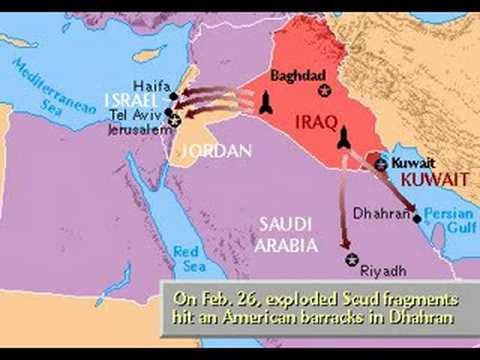
- The Gulf War, which lasted between August 1990 and February 1991, thus became an international conflict.
- The UN Security Council strongly condemned Iraq and warned of military action if its forces did not retreat by January 15, 1991.
- But Hussain refused to pay heed to the UN’s many warnings.
- So, a US-led coalition, consisting of 7 lakh troops from 35 countries assembled in Saudi Arabia.
- Saudi, Iraq’s neighbour, was also threatened by Hussain’s adventures in the region.
- After the January 15 deadline was breached by Baghdad, coalition forces first launched Operation Desert Storm.
- It destroyed Iraq’s air defences, oil refineries, and key infrastructure.
- This was followed by Operation Desert Sabre, a ground offensive that went on to free Kuwait.
- The war finally ended on February 28, 1991, when the US declared a ceasefire.
What was the impact?
- During the war, the Iraqi military is known to have lost between 8,000-50,000 people.
- In comparison, only around 300 casualties occurred on the coalition forces.
- According to the Kuwaiti government, around 605 people went missing during the Iraqi occupation of their country.
What was India's stance then?
- The Iraqi Baath party was one of the tools by which Saddam Hussein maintained a tight grip on his country.
- New Delhi had been one of the first powers to recognise the Baathist regime when it came to power.
- Baghdad, in turn, had consistently maintained a pro-India stance.
- This was especially active during the era when the rest of the region was seen to have gravitated towards Pakistan.
- When the Gulf War started, India maintained its signature non-aligned stance.
- However, it rejected Baghdad’s demand for linking the hostilities that were unfolding then with the Palestinian conflict.
- Between August and October 1990, India evacuated over 1,75,000 of its nationals from war-torn Kuwait, the biggest such operation by the Indian government.
- This has been mentioned in the Guinness Book of World Records as the largest number of people being evacuated by a civilian airliner.
Source: Indian Express
Quick Fact
Baathist regime
- The word Baath means renaissance in Arabic.
- The Arab Socialist Baath Party was founded in Syria in the 1940s.
- It was founded by a small group of French-educated Syrian intellectuals - Michel Aflaq, a Greek Orthodox, and Salah al-Din al-Bitar, a Sunni Muslim.
- A committed Baathist should see individual Arab states as regions or provinces of the larger Arab nation.


