Click here for Part-I
What is the issue?
- Some state governments have recently decided to make significant changes in the application of labour laws.
- While these changes are reportedly being brought about to incentivise economic activity after the lockdown, there are lot many wider concerns.
What are Indian labour laws?
- Estimates vary but there are over 200 state laws and close to 50 central laws on matters of labour.
- However, there is no set definition of “labour laws” in the country.
- Broadly speaking, they can be divided into four categories (as in the figure below).
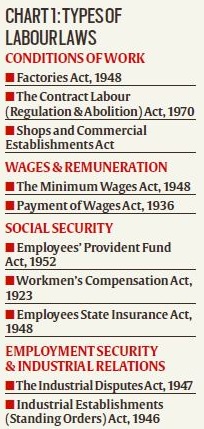
- The Factories Act aimed at ensuring safety measures on factory premises, and promoting health and welfare of workers
- The Shops and Commercial Establishments Act aims to regulate work hours, payment, overtime, weekly day off and other holidays with pay.
- It also regulates annual leave, employment of children and young persons, and employment of women.
- The Minimum Wages Act covers more workers than any other labour legislation.
- The most contentious labour law, however, is the Industrial Disputes Act, 1947.
- It relates to terms of service such as layoff, retrenchment, and closure of industrial enterprises and strikes and lockouts.
What are the concerns?
- Indian labour laws are often characterised as “inflexible”.
- Due to the strict legal requirements, firms (those employing more than 100 workers) are wary of hiring new workers.
- This is because firing them requires government approvals.
- So, even the organised sector is increasingly employing workers without formal contracts.
- This, in turn, has constrained the growth of firms on the one hand and provided a less favourable deal to workers on the other.
- Also, there are too many laws, often unnecessarily complicated, and not effectively implemented.
- This has laid the foundation for corruption and rent-seeking.
- [With fewer and easier-to-follow labour laws, firms would be able to expand and contract depending on the market conditions.
- Also, the resulting formalisation would help workers, as they would get better salaries and social security benefits.
- At present, 90% of India’s workers are part of the informal economy.]
What are the likely implications of states' decisions?
- UP, for instance, has summarily suspended almost all labour laws including the Minimum Wages Act.
- This is something like creating an enabling environment for exploitation.
- For instance, a firm could fire all existing employees and hire them again at lower wages, and no law would stop them from doing so.
- Moreover, this move will in one go turn the existing formal workers into informal workers as they would not get any social security.
- This would bring down the wage rate sharply, and the workers will have no way to even seek grievance redressal.
- Notably, even before the Covid-19 crisis, given the deceleration in the economy, wage growth had been moderating.
- Moreover, there was always a wide gap between formal and informal wage rates.
- E.g. a woman working as a casual labourer in rural India earns just 20% of what a man earns in an urban formal setting
Will the changes boost economic growth?
- Theoretically, it is possible to generate more employment in a market with fewer labour regulations.
- But the experience of states that have relaxed labour laws in the past suggests other way.
- Dismantling worker protection laws have failed to attract investments and increase employment.
- Employment will not increase primarily because there is already too much unused capacity.
- Firms are shaving off salaries up to 40% and making job cuts.
- The overall demand has fallen and so, firms are not likely to hire more employees right now.
- The work-hours move and the resulting fall in wages will only further depress the overall demand in the economy.
- It would hurt the economic recovery process too.
What should have been done?
- If states had strived for ensuring more people had jobs, then they should have allowed two shifts of 8-hours each.
- The government should have partnered with the industry and allocated 3% or 5% of the GDP towards sharing the wage burden.
- This would ensure the health of the labourers instead of creating exploitative conditions for them.
- If Covid-19 hits the labour class, the whole economy would take a hit, and this the government should take into account.
Source: Indian Express


