Why in news?
Ministry of Home Affairs (MoHA) has decided to reduce the central forces deployed under AFSPA Act in north-eastern states.
What is the AFSPA act?
- Armed Forces (Special Powers) Act 1958, gives armed forces the power to maintain public order in “disturbed areas”.
- It can be invoked in places where the use of armed forces in aid of the civil power is necessary.
- The causes could be differences or disputes between members of different religious, racial, language or regional groups or castes or communities.
- The Central or State/UT administration can declare the whole or part of a State or Union Territory as a disturbed area.
- MoHA would usually enforce this Act where necessary.
- Under this act armed forces can have the authority to prohibit a gathering of five or more persons in an area.
- They can use force or even open fire after giving due warning if they feel a person is in contravention of the law.
- If reasonable suspicion exists, the army can also arrest a person without a warrant.
- They can also enter or search a premise without a warrant, and ban the possession of firearms.
What is the account of AFSPA in North-Eastern states?
- The Act came into force in the context of increasing violence in the North-eastern States decades ago.
- They state governments clearly found it difficult to control.
- The Armed Forces (Special Powers) Bill was passed by both the Houses of Parliament.
- It was approved by the President in 1958.
- It became known as the Armed Forces Special Powers Act, 1958.
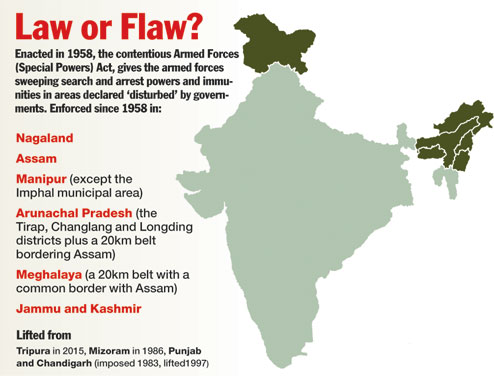
- It was effective in the whole of Nagaland, Assam, Manipur (excluding seven assembly constituencies of Imphal), Meghalaya and parts of Arunachal Pradesh.
What are the recent decisions?
- The Centre has revoked The Armed Forces (Special Powers) Act (AFSPA) from Meghalaya since April 1, 2018.
- Earlier the AFSPA was effective in 20 km area along the Assam-Meghalaya border.
- In Arunachal Pradesh the impact of AFSPA was reduced to 8 police stations instead of 16 police stations.
- The Ministry has also relaxed the Protected Area Permit (PAP) for foreigners visiting Manipur, Mizoram and Nagaland.
- The PAP will be valid for 5 years, but residents from Pakistan, Afghanistan and China will not be allowed to visit these areas.
- In 2017, the Home Ministry gave up its power and asked the Assam government to take a decision on continuing AFSPA in the State.
- Recently, Home Ministry has decided to reduce the number of central armed police force personnel deployed in the north-eastern States.
What are the further plans?
- In 2004, Union Government appointed a five-member committee headed by Justice B.P. Jeevan Reddy to review AFSPA, 1958.
- The committee submitted its report in 2005.
- Besides repealing the Act, it recommended that the Unlawful Activities (Prevention) Act, 1967 should be modified to clearly specify the powers of the armed forces and central forces.
- Union government is now considering a proposal to make AFSPA more operationally effective and humane by taking Jeevan Reddy committee’s report.
- Government’s recent moves also signify a willingness to reconsider the use of the special law as and when the ground situation improves.
- Thus, as of now, there is no sign that the vigour of the law will be diluted, but the area of its use may be progressively curtailed over time.
Source: The Hindu


