Goldschmidtite
- It is a new mineral from the Earth’s mantle, found inside a diamond in Koffiefontein, South Africa.
- It has been named after Victor Moritz Goldschmidt, the Norwegian scientist acknowledged as the founder of modern geochemistry.
- It has high concentrations of niobium, potassium and the rare earth elements lanthanum and cerium.
- It is an unusual chemical signature for a mineral from Earth’s mantle, which is usually dominated by elements such as magnesium and iron.
- Though the mantle makes up about 80% of the Earth’s volume but very little is known about it.
- Diamonds hold clues as they are found up to 160 km beneath the surface, in the upper mantle.
- Diamonds that are unearthed were brought up closer to the surface, probably as a result of violent volcanic eruptions when the Earth was hotter.
Galo Community
- The Galo community is one of the 26 major communities of Arunachal Pradesh.
- They are found in Siang, Subansiri, Lepa Rada districts.
- They belong to the Tani group inhabiting Assam and Arunachal Pradesh, besides Tibet.
- They trace their common origin to a primeval ancestor, Abotani.
- They have unique system of naming which helps them to maintain Genealogy (Tracing the names of ancestors).
- They have a system of prefixing the second syllable of a father’s name to that of a son, who passes on the suffix in his name to his son.
- But unlike the Mising (Assam), Adi, Apatani, Nyishi and Tagin, the other communities do not have this practice.
Naming of an Asteroid
- International Astronomical Union (IAU) serves as the internationally recognized authority for assigning designations to celestial bodies and surface features on them.
- According to IAU’s guidelines, the privilege of naming a planet is first given to discoverers, who have 10 years to propose a name.
- The discoverer or team is expected to write a short citation, explaining the reasons for assigning the name.
- All names proposed are judged by the 15-member Working Group for Small Body Nomenclature (CSBN) of the IAU.
- It has recently named an asteroid after Indian classical singer Pandit Jasraj.
- It is located between Mars and Jupiter, and was discovered on November 11, 2006 by the Arizona based telescope.
Lithium deposits in Bolivia
- Lithium Triangle is an intersection of Chile, Bolivia and Argentina, known for high quality salt flats.
- Salar de Uyuni in Bolivia, Salar de Atacama in Chile and Salar de Arizaro in Argentina contains over 45%of known global lithium reserves.
- Beneath Salar de Uyuni, the world’s largest salt flat lies the world’s greatest lithium deposits.
- Bolivia, one of South America’s poorest countries, envisions development by harvesting lithium on an industrial scale from underground saltwater brines.
- It can be mined from rock or processed from brine.
- Lithium dissolved in underground saline aquifers called “brine”, pumped to surface by wells and then allowed to evaporate in vast knee-deep ponds.
- A demand for electric vehicles and smart devices powered by lithium-ion batteries gives an opportunity for the development.
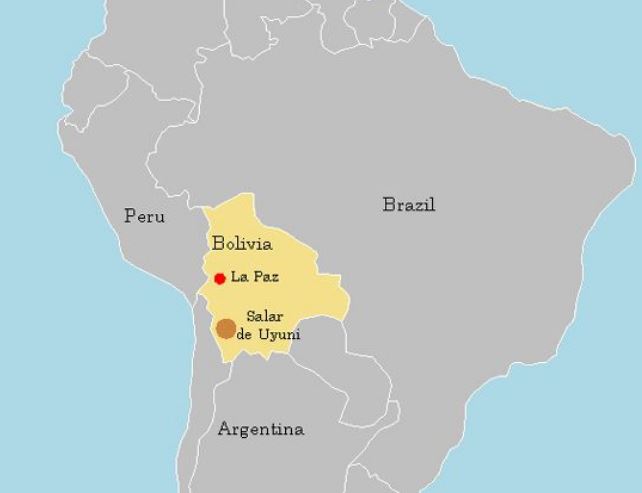
Source: The Hindu, The Indian Express, Graphic News


