Shagun
- Union HRD Ministry launched Integrated Online junction for School Education ‘Shagun’.
- It is one of world’s largest system of its kind to improve school education,
- by creating a junction for all online portals and websites relating to various activities of the Department of School Education and all States and Union Territories.
- The word ‘Shagun’ is coined from two different words,
- ‘Shala’ meaning Schools and
- ‘Gunvatta’ meaning Quality
- Websites of Kendriya Vidyalayas, Navodaya Vidyalayas, other CBSE affiliated schools, SCERTs, among others are integrated with ‘Shagun’.
- The portal seeks to connect approximately 92 lakh teachers and 26 crores, students.
- Common people can directly give their feedback about schools which will further increase public participation.
- ‘Integrated National School Education Treasury’ (INSET) is to be set up,
- It envisages a fully integrated, instantly accessible and seamless information network for all parameters relating to the students, teachers, and schools in the country.
- The main focus areas will be,
- Reinforcing and cleaning the data of the Integrated Online Junction through feedback from Stakeholders.
- Ensuring full inter-operability among the websites, portals and applications which are already hosted in the junction.
- Creating high-quality e-contents, including quizzes and puzzles to enhance learning.
- Using artificial intelligence and deep machine learning in a variety of ways to enhance the quality of school education.
H1N1 Influenza Outbreak
- In 2009, the first case of ‘Influenza A’ H1N1 was reported in Mexico, later the infection spread to a total of 214 countries.
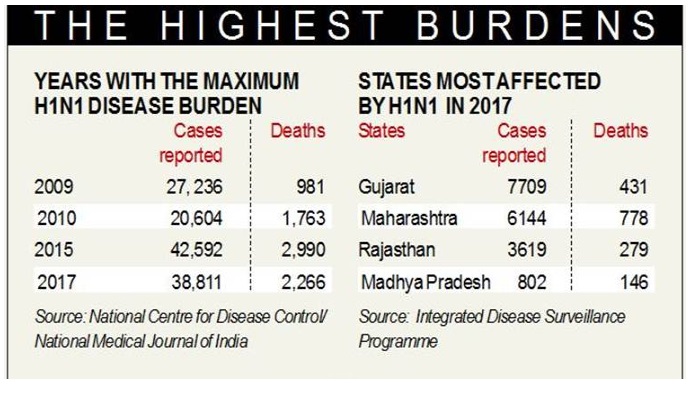
- 10 years since H1N1 outbreaks in India, saw as many as 1.58 lakh persons being infected and over 10,000 succumbing to it.
- H1N1 (Swine Flu) is an infection caused by a virus, a subtype of Influenza A virus (a communicable viral disease).
- It is a common infection in ‘pigs’ worldwide and it can potentially infect the respiratory tract of pigs.
- Sometimes, people who are closely associated with pigs or in the proximity of pigs have developed swine flu.
- Since the virus is contagious, it can spread from human to human.
- Respiratory transmission occurs mainly by droplets disseminated by unprotected coughs and sneezes.
- Hand contamination and direct inoculation of the virus is another possible source of transmission.
- An analysis in India shows that ‘Maharashtra’ has reported the highest number of cases and deaths since the influenza outbreak.
- In the temperate countries, peak influenza activity is recorded in winters.
- In the tropical and sub-tropical countries like in India, the primary peak of influenza activity is during the monsoon.
- Overcrowding leads to increased transmission of airborne infection in India.
- Infection cases are reported mainly from western parts of India, localised to Pune in Maharashtra and Jaipur in Rajasthan.
- North-eastern states like Arunachal Pradesh and Tripura, which had never reported H1N1 in the past, notified 44 cases in 2017.
- According to researchers, observations require further probe to understand the changing ecological and transmission dynamics.
Coprolite
- Coprolites are fossilised faeces belonging to animals that lived millions of years ago.
- Scientists have found the oldest parasite DNA ever recorded.
- The discovery was made in the Coprolite of a prehistoric puma in Argentina.
- With the help of carbon dating, it is estimated that the age of the coprolite is between 16,500-17,000 years ago.
- Using ancient mitochondrial DNA analysis, it was confirmed that the coprolite came out of a puma.
- This led to the identification of the oldest parasite DNA found yet dated back to a few thousand years ago.
CoP18 of CITES
- The Indian star tortoise was upgraded to CITES Appendix I (threatened with extinction).
- It got the highest level of international protection from commercial trade.
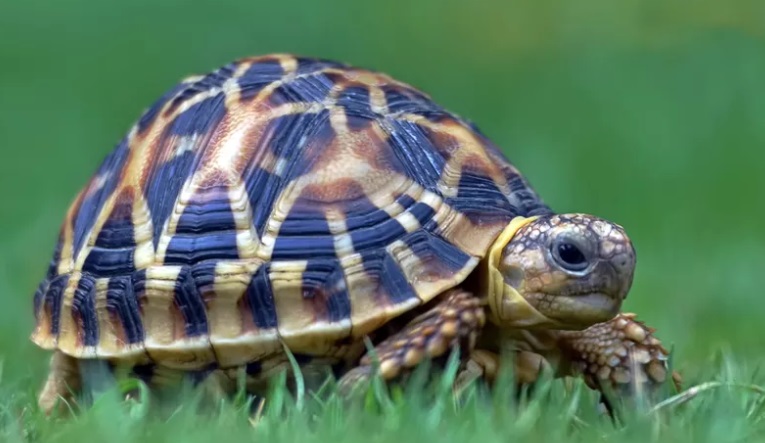
- The Indian star tortoise is an IUCN-listed ‘Vulnerable’ species.
- It is being illegally trafficked despite restrictions on its trade.
- To combat the stress (largely from trading), range states like Sri Lanka and India, submitted a proposal to CITES summit.
- It is to move the star tortoise from Appendix II to Appendix I, it was passed with a majority by nations participating in CITES.
- Now it prohibits international trade of these species except when the purpose of the import is for scientific research.
- They are native to India and found only in Sri Lanka, some parts of India and adjoining Pakistan.
- ‘Sharks’ gets special protection -
- 18 species of sharks and rays, threatened by the scale of international trade in their fins and meat, were included in Appendix II of the Convention.
- This will limits the trade to sustainable levels.
- No more trade in ‘African elephants’ -
- Parties vote to restrict trade from Zimbabwe and Botswana.
- They can no longer be shipped to zoos and circuses worldwide
- This will save an untold number of baby elephants from being torn from their mothers, beaten during capture and conscripted into a lifetime of captivity.
- Zimbabwe made $2.7 million by selling 97 live elephants to China and the United Arab Emirates between 2012 and 2018.
- ‘Giraffes’ accorded protection from trade for the first time -
- The giraffe has been placed in Appendix II of CITES.
- This places prohibitions on uncontrolled trade.
- They have been listed as ‘Vulnerable’ on the IUCN list.
- 40% decline of African giraffe has been recorded over the last 30 years.
Source: PIB, The Indian Express