How India protects its VIPs
- Recently, Central government has withdrawn Special Protection Group (SPG) security cover to former PM Dr.Manmohan Singh.
- The former Prime Minister will now be given ‘Z-plus’ cover by the Central Armed Police Forces (CAPF).
- Decision to withdraw the security cover of these protectees was taken at a meeting of the Security Categorisation Committee.
- CAPF, the umbrella term for 7 security forces under the ‘Ministry of Home Affairs’,
- The Assam Rifles,
- The Border Security Force (BSF),
- The Central Reserve Police Force (CRPF),
- The Central Industrial Security Force (CISF),
- The National Security Guard (NSG),
- The Indo-Tibetan Border Police (ITBP), and
- The Sashastra Seema Bal (SSB).
- After Indira Gandhi was assassinated by her own security guards, the government decided to create a special cadre of security personnel for the Prime Minister.
- Following the recommendations of a committee set up by the Home Ministry, a special unit was created for this purpose under the Cabinet Secretariat.
- This unit, initially called the ‘Special Protection Unit’, was renamed as ‘Special Protection Group’ (SPG).
- Subsequently, the Parliament passed ‘The Special Protection Group’ (SPG) Act,
- To provide for the constitution and regulation of an armed force of the Union.
- For providing proximate security to the PM of India and for matters connected therewith.
- The SPG Act defined “proximate security” as,
- Protection provided from close quarters, during journey by road, rail, aircraft, watercraft or any other means of transport.
- It also “includes the places of functions, engagements, residence or halt”.
- Then SPG protection was extended, apart from the PM, to former PMs of India and members of their immediate families.
- It was done through an amendment in the Act in the aftermath of the assassination of Rajiv Gandhi.
- Besides the SPG, VIPs in India are protected by other security forces as well.
- The levels of security cover are determined by the threat perception around the individual.
- The highest level of security cover is the ‘Z-plus’ category, followed by Z, Y, and X categories.
- The higher the level of cover, the larger the number of personnel protecting the individual.
- For ‘Z-plus’ category protectees, roughly 24-36 personnel with automatic weapons are deployed.
- For ‘Z’ category, roughly 16-20 personnel guard the protectees.
- The elite ‘Black Cat’ commandos of the NSG are deployed to protect VIPs for whom the threat perception is the highest.
Fedor the Robot
- Recently, the humanoid robot ‘Fedor’, the first from Russia sent into orbit, reached the International Space Station (ISS).
- ‘Fedor’ short for ‘Final Experimental Demonstration Object Research’ can be operated manually by ISS astronauts wearing robotic exoskeleton suits.
- It copies human movements, which will enable it to perform tasks that are risky for astronauts strapped onto an exoskeleton.
- It is an anthropomorphic robot, ideal option for an assistant, and in some cases a complete replacement for a person.
- Fedor was sent in an unmanned Soyuz capsule to ISS.
- Fedor will spend 10 days on the International Space Station, learning tasks performed by astronauts.
- Other countries that have previously sent their robot’s are,
- In 2011, NASA sent up ‘Robonaut 2’.
- In 2013, Japan sent up a small robot called ‘Kirobo’.
- The International Space Station (ISS) has been orbiting Earth at about 28,000 kilometres per hour since 1998.
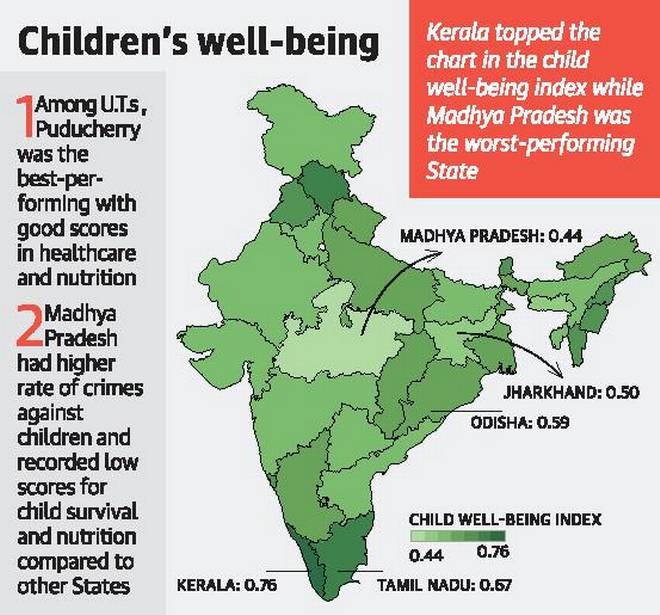
India Child Well-Being Report
- The report has been prepared by ‘World Vision India’ (child-focused humanitarian organisation) and ‘IFMR LEAD’ (research organisation) based in India.
- Children are the happiest in Kerala and the least happy in Madhya Pradesh.
- Kerala, Tamil Nadu, Himachal Pradesh and Puducherry topped the charts while Meghalaya, Jharkhand and Madhya Pradesh featured at the bottom.
- Poor nutrition and low child survival rate has pushed Jharkhand and Madhya Pradesh to the bottom of an index.
- Findings based on a study of 24 data indicators including,
- The indicators are a mix of health, education, human rights, family income and so on.
- Health indicators such as,
- Stunting and Infant mortality, Under-five mortality rate,
- Mental health/illnesses, Sex-ratio,
- Adolescent pregnancy (women aged 15 to 19 years who were already mothers or pregnant),
- Education indicators such as passing tenth grade,
- The pupil-teacher ratio, basic reading and math skills, drop-out rates in secondary school,
- Crime indicators such as juvenile crimes, suicide rates,
- Economic indicators such as houselessness, households with income less than Rs 5,000 and
- Labour indicators such as manual scavenging.
- All indicators were brought to a common scale of measurement and normalised.
- Among the UTs, the National Capital Territories of Delhi scored 0.53, closely followed by Dadra Nagar Haveli at 0.52.
- The report is important considering that 40% of the country’s population is made of children between the ages of 1 and 18.
Source: PIB, The Indian Express


