Gravitational lensing
- Using NASA’s James Webb Space Telescope researchers plan to investigate how new stars are born.
- For this, a natural phenomenon called “Gravitational lensing” is to be used.
- The gravitational field of a massive object will extend far into space, and cause light rays passing close to that object to be bent and refocused somewhere else.
- This phenomenon is ‘Gravitational lensing’, simply put, ‘mass bends light’.
- The effect is analogous to that produced by a lens.
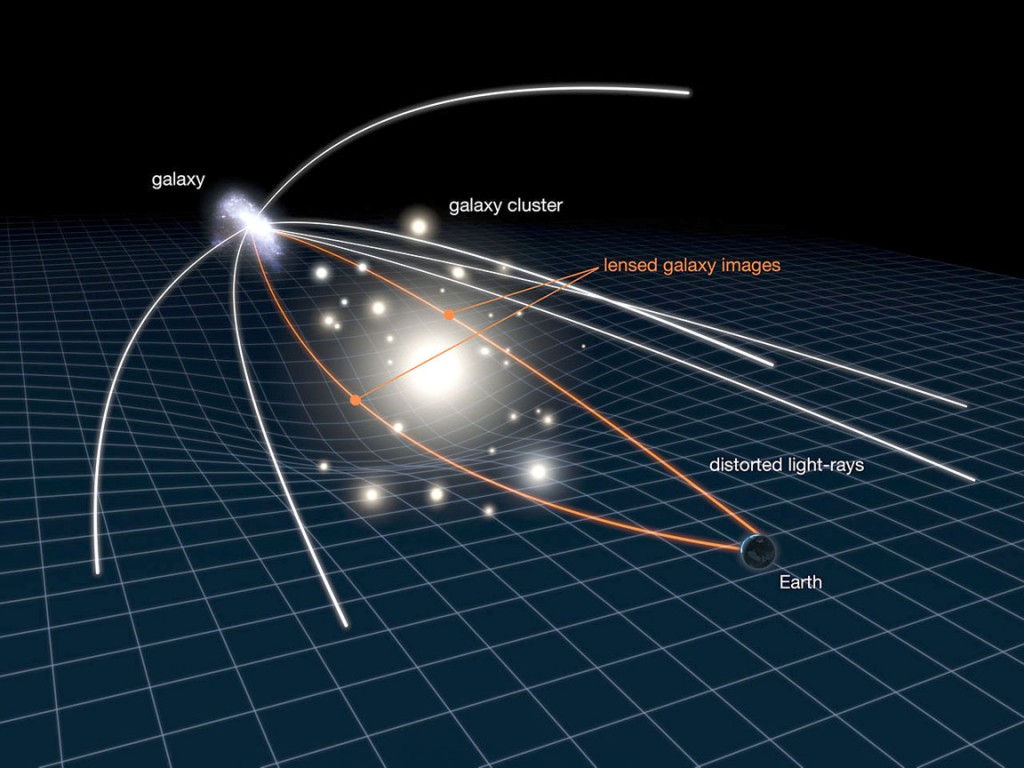
- The more massive the object, the stronger its gravitational field and hence the greater the bending of light rays.
- It is just like using denser materials to make optical lenses results in a greater amount of refraction.
- In effect, these are natural, cosmic telescopes, called gravitational lenses.
- These large celestial objects will magnify the light from distant galaxies that are at or near the peak of star formation.
- The effect allows researchers to study the details of early galaxies too far away.
- Gravitational lensing happens on all scales,
- The gravitational field of galaxies and clusters of galaxies can lens light.
- On smaller objects such as stars and planets.
- Even the mass of our own bodies will lens light passing near us a tiny bit, although the effect is too small to ever measure.
- The Milky Way today forms the equivalent of one Sun every year, but in the past, that rate was up to 100 times greater.
- NASA now plans to look billions of years into the past in order to understand how our Sun formed.
- The programme is called ‘Targeting Extremely Magnified Panchromatic Lensed Arcs and Their Extended Star Formation’, or TEMPLATES.
CoP 18 of the CITES
- Over 100 nations, acting within the framework of CITES, approved a proposal by India, Nepal and Bangladesh.
- It is to prohibit commercial international trade in a species of ‘Otter’ native to the subcontinent and some other parts of Asia.
- The Conference also accepted a separate proposal by India, moved together with the EU, the US and the Philippines.
- It is for inclusion of a species of ‘Gecko lizard’ for protection as a species not necessarily threatened with extinction.
- It is found widely in South Asia, the US, and Madagascar.
- To control the trade in order to avoid utilisation incompatible with their survival.
- Members voted to move the Smooth-coated otter (Lutrogale perspicillata) from CITES Appendix II to CITES Appendix I.
- It is considered to be facing a high risk of extinction
- It is detrimentally affected by international trade and habitat loss.
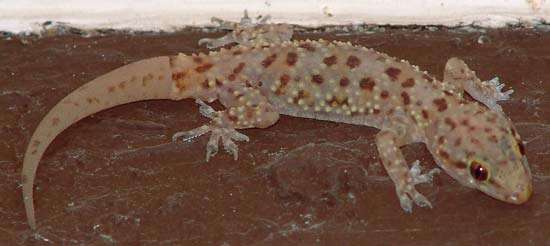
- The other proposal that was passed was to include the ‘Tokay gecko’ (Gekko gecko) in CITES Appendix II.
- India had proposed Appendix I status for the small-clawed otter, mako shark, the Indian star tortoise and the Tokay gecko.
CITES
- It is an international agreement aimed at ensuring that international trade in specimens of wild animals and plants does not threaten their survival.
- It was drafted after a resolution was adopted at a meeting of the members of the IUCN in 1963.
- Convention was agreed in Washington DC, therefore, sometimes referred to as the ‘Washington Convention’.
- It entered into force on July 1, 1975, and now has 183 parties.
- States and regional economic integration organisations adhere voluntarily to CITES.
- The Convention is legally binding on the Parties in the sense that they are committed to implementing it.
- However, it does not take the place of national laws and it provides a framework for Parties to make domestic legislation.
- To ensure that the Convention is implemented effectively in their national jurisdictions.
Images from Chandrayaan-2
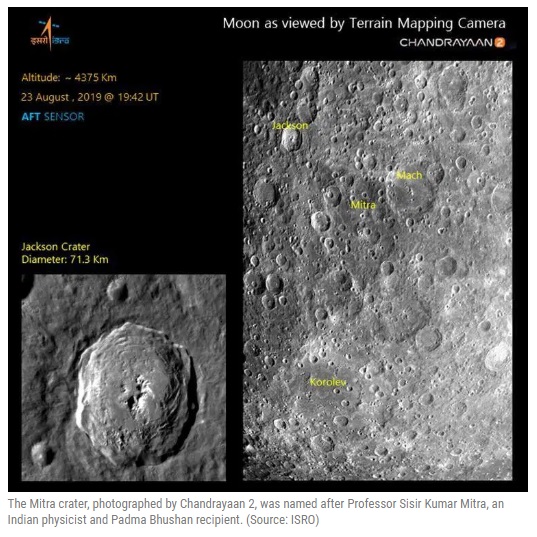
- ISRO released the images of the lunar surface captured from the Chandrayaan-2 spacecraft orbiting the Moon.
- Taken by the Terrain Mapping Camera-2 of Chandrayaan-2, the images show, craters named after various scientists,
- The system of nomenclature evolved over the years and is now standardised.
- In a resolution by the International Astronomical Union in 1973, crater and crater-like formations are given the names of astronomers or eminent scientists , posthumously.
- Among other lunar features,
- Mountains are given names corresponding to the geographical names of mountains of the Earth,
- The extensive dark surfaces are given names that correspond to the mental states of humans.
Source: PIB, The Indian Express


