International Migrant Stock 2019
- The International Migrant Stock 2019, a dataset released by the Population Division of the UN Department of Economic and Social Affairs (DESA).
- It provides the latest estimates of the number of international migrants by age, sex and origin for all countries of the world.
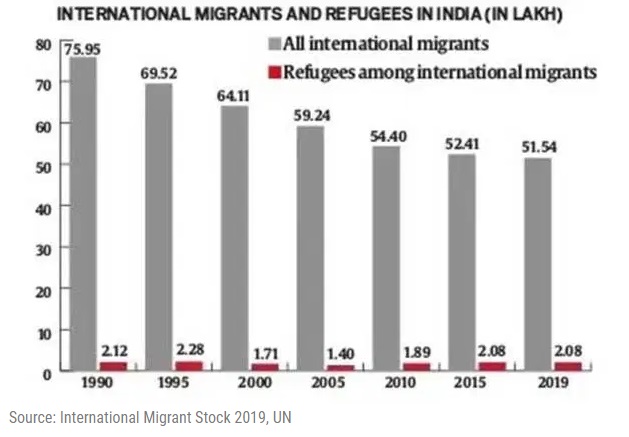
- According to the data, there are 51,54,737 international migrants represent just 0.4% of the total population of India in 2019.
- The number has been consistently going down in the last 3 decades
- From 75.9 lakh in 1990, to is 51.5 lakh in 2019.
- Of the international migrants in India in 2019, the country of origin for 31 lakh or just over 60% was Bangladesh.
- Another 21% were originally from Pakistan and 10% from Nepal.
- The data encompass any person who moved across an international border, either intentionally or involuntarily.
- The international migrant population across all countries is 27.2 crore, who represent 3.5% of the total global population.
- Of these 27.2 crore, 1.75 crore are Indian migrants living in various countries.
- The proportion of women among international migrants in India is at 48.8%.
- This is higher than the 47.9% proportion of women among international migrants across countries.
- Increase in global number of international migrants continues to outpace growth of the world’s population.
- In 2019, regionally,
- Europe hosts the largest number of international migrants (82 million), followed by
- Northern America (59 million) and
- Northern Africa and Western Asia (49 million).
- At the country level, about half of all international migrants reside in just 10 countries, United States hosting the largest number of international migrants (51 million), equal to about 19% of the world’s total.
- In terms of age, 1 out of every 7 international migrants is below the age of 20 years, 3 out of every 4 international migrants are of working age (20-64 years).
Pakistan Occupied Kashmir (PoK) and Gilgit Baltistan (GB)
- Recently, External Affairs Minister said that one day India is expected to have a physical jurisdiction over PoK.
- PoK, an area of 13,297 sq km, which was under the control of the Pakistani forces when the ceasefire line came into effect on January 1, 1949.
- PoK has a population of over 40 lakh, according to a census carried out in 2017.
- The capital of PoK is Muzaffarabad, a town located in the valley of the Jhelum river .
- It is divided into 10 districts.
- In 1963, through an agreement, Pakistan ceded to China over 5,000 sq km of J&K land under its control, in the Shaksgam area, in northern Kashmir, beyond the Karakoram.
- Gilgit Baltistan is a picturesque, hilly region to the north of PoK.
- The British sold it, along with the rest of J & K, to the Dogra ruler of Jammu, Gulab Singh, after defeating Sikh army in 1846, but retained controlled over the area through a lease extracted from the Maharaja.
- This lease was last renewed in 1935.
- In 1947, a British army officer imprisoned Maharaja Hari Singh’s governor in the region, and handed over the area for accession to Pakistan.
- Gilgit Baltistan (GB) is spread over 72,871 sq km, and is five-and-a-half times the size of PoK.
- But it is sparsely populated, with just under 20 lakh people.
- Though both PoK and GB are ruled directly from Islamabad, neither is officially listed as the territory of Pakistan.
- Pakistan has just 4 provinces: Punjab, Khyber Pakhtunkhwa (which now includes FATA), Balochistan, and Sindh.
- PoK and GB are both “autonomous territories”.
- Pakistan has kept this fiction going, as incorporating these areas into its map would damage its international position in the UN.
- For India, on the other hand,
- as per the resolution passed by Parliament in 1994,
- PoK and GB are both part of the State of Jammu and Kashmir,
- And Jammu and Kashmir is an integral part of India by virtue of its accession to India in 1947.
- It also demanded that, Pakistan must vacate the areas of the Indian State of J&K, which they have occupied through aggression.
National Educational Alliance for Technology (NEAT)
- NEAT is a public-private partnership scheme aims to harness technology for better learning outcomes in higher education.
- This initiative under ‘Ministry of Human Resource Development’ is to provide wider access to adaptive learning technologies.
- The new scheme NEAT is in partnership with companies using Artificial Intelligence.
- To make learning more personalised and customised as per the learner’s requirements.
- Start-ups which join the government platform must offer 25% free coupons for students from disadvantaged communities.
- MHRD would act as a facilitator to ensure that the solutions are freely available to a large number of economically backward students.
- It would create and maintain a National NEAT platform that would provide one-stop access to technological solutions.
- NEAT will be administered by an apex committee constituted by the Ministry.
- It will have an independent expert panels, being set up to evaluate and select the best EdTech solutions.
Source: PIB, The Indian Express


