Tardigrade
- On April, the Israeli spacecraft ‘Beresheet’ attempted to land on the Moon, but crashed on the surface.
- It was carrying a number of items, including thousands of specimens of a living organism called ‘Tardigrade’.

- It is also called “Water bear” or “Moss piglet”, a free-living tiny invertebrates.
- It can only be seen under a microscope. Half a millimetre long, it is essentially a water-dweller but also inhabits land.
- It can survive in the cold vacuum of outer space and it can endure extreme hot and cold temperature levels.
- It looks like an eight-legged bear, with a mouth that can project out like a tongue.
- Its body has 4 segments supported by 4 pairs of clawed legs.
- A tardigrade typically eats fluids, using its claws and mouth to tear open plant and animal cells, so that it can suck nutrients out of them.
- It is also known to feast on bacteria and, in some cases, to kill and eat other tardigrades.
- Although they are famed for their resilience, they are destructible too.
- A study found that if all other life were to be wiped out by a cataclysmic event, a large asteroid or a supernova, the ‘Tardigrade’ would be the likeliest to survive.
- The tardigrades on the spacecraft were dehydrated and the organism is known to come back to life on rehydration.
- On the Moon, they have to find liquid water and revive, the Tardigrades might not last very long in the absence of food and air.
Beresheet
- It is a Israeli robotic lander for a lunar probe.
- It had carried human DNA samples, along with the ‘Tardigrades’ and 30 million small digitized pages of information about human society and culture.
- It crashed and spilled the tardigrades on the Moon.

Sulphur dioxide emission
- A new report by Greenpeace India shows, India is the largest emitter of sulphur dioxide in the world.
- The report also includes NASA’s data on the largest point sources of sulphur dioxide.
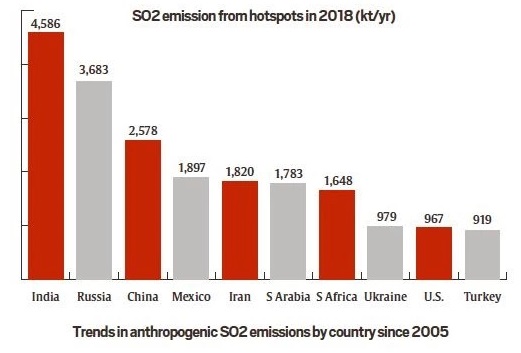
- More than 15% of all the anthropogenic SO2 hotspots are in India, as detected by the NASA OMI (Ozone Monitoring Instrument) satellite.
- Almost all of these emissions are because of coal-burning.
- The vast majority of coal-based power plants in India lack flue-gas desulphurisation technology to reduce air pollution.
- To combat pollution levels, the MoEFCC introduced,
- SO2 emission limits for coal-fired power plants in 2015.
- But the deadline for the installation of flue-gas desulphurisation (FGD) in power plants has been extended from 2017 to 2022.
- Air pollutant emissions from power plants and other industries continue to increase in India, Saudi Arabia and Iran.
- China and the US have reduced emissions rapidly by switching to clean energy sources and enforcement for SO2 control.
Pradhan Mantri Ujjwala Yojana (PMUY) - a timely policy intervention
- A study published by the Collaborative Clean Air Policy Centre, states that the single greatest contributor to air pollution in India is the burning of solid fuels in households.
- The burning of such solid fuels, like firewood, impacts the health of household members.
- It accounts for somewhere between 22% to 52% of all ambient air pollution in India.
- The study states that, switching to cleaner fuels such as LPG for household use will have a dramatic impact on pollution levels and health problems due to pollution.
- Firewood, animal dung, and agricultural waste are some of the fuels commonly used in households across India as a means of generating energy for cooking, light, and heating.
- One of the many pollutants produced on the burning of such solid fuels is fine particulate matter.
- The emissions of PM2.5 generated by the burning of solid fuels in households is termed Household Air Pollution (HAP).
- The study claims that approximately 800,000 premature deaths occur in India every year as a result of exposure to HAP indoors.
- The HAP produced indoors travels outdoors, and becomes a contributor to ambient air pollution.
- The contribution of HAP to premature mortality is, as per the median across all studies,
- 58% higher than premature mortality due to coal use,
- 303% higher than that due to open burning, and
- 1,056% higher than that due to transportation.
- In states such as Bihar, Uttar Pradesh, Madhya Pradesh, Orissa, Jharkhand, Rajasthan, Chattisgarh and Assam
- Around 72.1% of the population regularly uses solid fuels, and
- The median annual ambient is 125.3µg/m^3, a level that is rated “unhealthy” as per the Air Quality Index, and
- It lead to serious health concerns with prolonged exposure.
- The study asserts government to promote LPG use in households, such as the PMUY.
Source: PIB, The Indian Express