New Districts creation in any state
- Recently Tamil Nadu CM announced that Vellore district would be trifurcated to create 2 more districts, Ranipet and Tirupattur.
- A ‘district’(zila) is an administrative division of an Indian state, there are around 727 Districts in India.
- The idea behind creating new districts in any state is, generally to make governance easier, sometimes driven by local demands.
- The number and size of districts vary from state to state.
- The larger states predicatbly have a higher number of districts, Uttar Pradesh (75), followed by Madhya Pradesh (52).
- The smallest state, Goa (2), has the lowest number.
- However, the number of districts in a state is not always a function of the area of the state, or of its population.
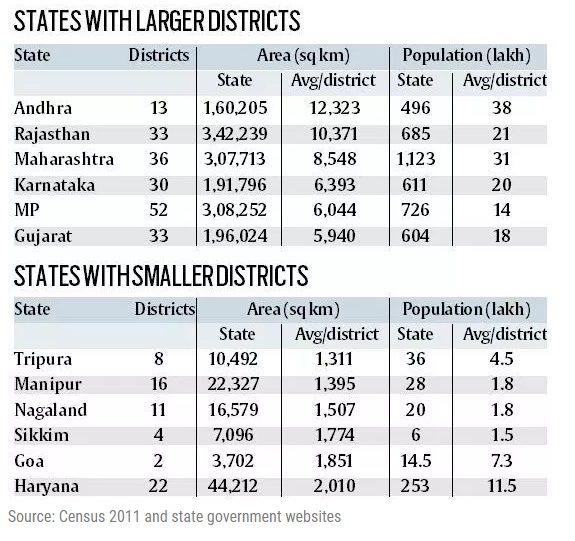
- For example, Andhra Pradesh is the 7th largest state by area but has among the smallest counts of districts at 13.
- It has only one district for every 12,000 sq km, the largest average size for a district in any Indian state.
- Tripura, being a small state, has only 8 districts.
- But it is high, when compared to any other states, in terms of the number of districts per unit area.
- It has one district for every 1,300 sq km, the smallest average district size in the country.
- An average Andhra Pradesh district is more than 9 times the size of an average Tripura district.
- An Andhra Pradesh district has an average population of 38 lakh while a Tripura district has only 4.5 lakh.
- Most of the Northeastern states have smaller districts, which means a higher number of districts per unit area.
- Tamil Nadu’s 37 districts will be the 4th highest count in the country.
- The average size of a Tamil Nadu district will now be around 3,500 sq km, down from 4,000 sq km earlier.
- Uttar Pradesh(75), Madhya Pradesh(52), Bihar(38) are the top 3 states with highest number of districts.
Panchamirtham of Palani temple gets GI tag
- The renowned ‘Palani Panchamirtham’ which is served as the prasadam in Palani temple was bestowed with the tag recently.
- This is the first time a temple ‘prasadam’ from Tamil Nadu has been bestowed with the GI tag.
- Panchamirtham finds mention in the ancient Tamil texts and this offering is said to be dating back to the 9th-century AD.
- In Tamil, ‘Pancha’ means five and 'amirtham' refers to divine nectar.
- It is made by combining in a prescribed proportion 5 natural substances, banana, cow ghee, cardamom, jaggery and honey.
- Dates and sugar candies are added to it for extra flavours.
- The GI limitation for producing the Panchamirtham is not limited to the temple alone, but to the Palani town.
- The Palani panchamirtham is made under the guidance of Mysuru’s Central Food Technological Research Institute, a Government of India undertaking. It is also certified by FSSAI.
- It is reportedly made without adding any water, preservatives, artificial ingredients, or any chemical processes.
- The whole process of producing panchamirtham is automated to cater to the increasing demand.
- ‘Tirupati Laddu’ is another temple prasadam which has a GI tag.
Geographical Indications Tag
- It is a sign used on products that have a specific geographical origin and possess qualities or a reputation of that origin.
- It conveys an assurance of quality and distinctiveness which is attributable to the specific geographical locality.
- It is valid for a period of 10 years following which it can be renewed.
- Geographical Indications of Goods (Registration and Protection) Act, 1999 (GI Act) is an act for protection of GI in India.
- India, as a member of the WTO enacted the Act to comply with the Agreement on Trade-Related Aspects of Intellectual Property Rights.
- Geographical Indications protection is granted through the TRIPS.
Total Fertility Rate (TFR)
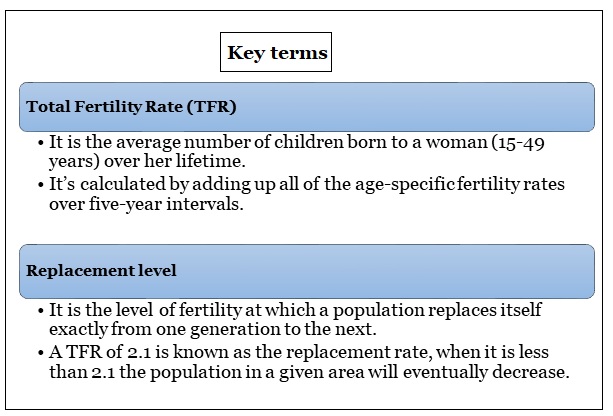
- TFR, defined as the number of children born to a woman until the end of her child-bearing age.
- It is a key indicator for population trends.
- India is expected to soon overtake China as the world’s most populous country.
- The TFR has been falling almost everywhere in India.
- The graph is based on TFR data from the Sample Registration System (SRS) undertaken by the Office of the Registrar General.
- SRS estimates provide dynamic trends underlying the population growth.
- For the four successive years (2013-2016) the TFR stagnated at 2.3 births per woman of child-bearing age.
- The latest SRS estimates (2017) show the TFR dropping to 2.2.
- This figure is only marginally higher than the fertility rate (2.1) required for replacement of the existing population.
- Even the states that have a higher TFR, UP(3.0), Bihar(3.2), MP(2.7), Rajasthan(2.6), Assam(2.3), Jharkhand(2.5) have been witnessing a declining trend in fertility rates.
- Gujarat and Haryana, recorded a TFR of 2.2, which is above the replacement rate but is equal to the national average.
- These 9 major states account for 52% of the 2011 population.
- States with a lower TFR include,
- Kerala (1.7),
- Tamil Nadu (1.6),
- Karnataka (1.7),
- Maharashtra (1.7),
- Andhra Pradesh (1.6),
- Jammu and Kashmir (1.6).
- The replacement level in these states is either 2.1 or has gone below it.
Everest climbers set to face new rules
- Nepal has proposed to tighten regulations after a deadly season.
- It is set to to address deadly human traffic jams on Mount Everest and to weed out inexperienced climbers.
- A panel advising Nepal's government has recommended that the applicants,
- Should first have to demonstrate that they are experienced mountaineers.
- Must already have climbed a Nepali peak of at least 6,500m.
- Should provide a certificate of physical fitness, and employ experienced guides.
- The committee also proposed a fee of at least $35,000 for Everest and $20,000 for other mountains over 8,000m.
- Climbers to Sagarmatha and other 8,000m mountains must undergo basic and high altitude climbing training,
Source: PIB, The Indian Express


