Kavalappara landslide
- Kavalappara village has become the sorrow of Kerala with about 63 people feared dead in the massive landslide.
- It is a hill in Western Ghats in Malappuram district which buried a part of a village.
- A mass of mud, gravel, and boulders came sweeping down, uprooting hundreds of trees along the way.
- In neighbouring Wayanad district there was a landslide at ‘Puthumala’, a plantation village.
- The two landslide sites are on either side of a section of the ecologically sensitive Western Ghats.
- Both regions are among the top 10 places that were marked as highly vulnerable to landslides, as per Kerala State Disaster Management Authority.
- Incessant rain pounded the region of Puthumala first and then floodwaters swept away the village.
- As the soil had not hardened post the last year's floods, the possibilities of such disasters were high this year.
- Landslides were reported from 80 regions in eight districts during two days this year, as per the government records.
Status of Reservoir levels in India
- Reservoirs exceed normal levels for this stage of the year after heavy rain in Maharashtra and Gujarat, way below normal in rain-hit Kerala and Karnataka.
- Central Water Commission (CWC) is monitoring live storage status of 103 reservoirs of the country on weekly basis.
- It publishes the report on 'Storage Position of the Reservoirs' which shows the information of All India, State wise and Reservoir wise.
- 91 reservoirs are divided in five regions namely,
- Northern Region - Himachal Pradesh, Punjab and Rajasthan.
- Eastern Region - Jharkhand, Odisha, West Bengal and Tripura.
- Western Region - Gujarat and Maharashtra
- Central Region - Uttar Pradesh, Uttarakhand, Madhya Pradesh and Chhattisgarh.
- Southern Region - Andhra Pradesh, Telangana, AP&TG (2 combined projects in both states) Karnataka, Kerala and Tamil Nadu.
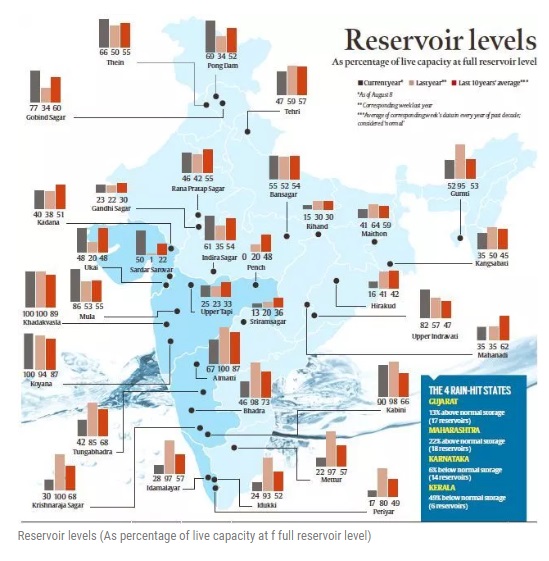
- The 103 reservoirs have only 4 % of their live storage capacity by 8th August despite having heavy monsoon rainfall.
- In Gujarat and Maharashtra, storage in the 35 reservoirs has surpassed the 10-year average (considered normal), following incessant rainfall over the Western region.
- The Western region has 35 reservoirs, in Maharashtra and Gujarat whose current live storage is 54% of their capacity.
- In the Southern region are 32 reservoirs under CWC monitoring, which has a live storage of 42% of total storage capacity.
- This is below the storage during the corresponding period of last year (62%) as well as the 10-year average (50%).
- The storage in the 14 reservoirs of Karnataka is 6% below normal.
- In the 6 reservoirs of Kerala, storage is as much as 49% below normal for this time of the year.
- Of the 32 reservoirs in the entire Southern region, as many as 19 have reserves that are below 40% of full level.
- The lowest deficit is in Telangana, where the two reservoirs are 62% below normal.
- Tamil Nadu’s 6 reservoirs are 55% below normal.
- Northern India’s 6 reservoirs, has 69 % of their total live storage capacity.
- It have exceeded the corresponding storage at this time last year (39%) as well as the 10-year average during monsoon (56%).
- In Central India, the 14 reservoirs have 44 % of total live capacity
- This is better than last year’s corresponding status (42%) but lower than the 10-year average for this period (4 %).
- Uttar Pradesh’s reservoirs are at 54% below normal.
- In the Eastern region, the 16 reservoirs have 32 % of total live capacity, which is lower than last year’s corresponding status (47%) as well as the 10-year average for this period (39%).
Consumer Price Index (CPI)
- CPI along with Wholesale Price Index (WPI) are 2 widely used indexes to calculate the inflation in the country.
- CPI measure changes over time in general level of prices of goods and services that households acquire for consumption.
- The National Statistical Office (NSO), Ministry of Statistics and Programme Implementation is releasing CPI (Rural, Urban, Combined) with the base year 2012 as monthly basis.
- It is widely used as a macroeconomic indicator of inflation, as a tool by governments and central banks for inflation targeting.
- It is also used for indexing dearness allowance to employees for increase in prices.
- India has adopted 4 CPIs.
- CPI (Industrial Workers)
- CPI (Urban Non- Manual Employees)
- CPI (Agricultural Labour)
- CPI (Rural Worker)
- Monthly price data are collected from 1114 markets in 310 selected towns by NSSO and from 1181 selected villages by the Department of Posts.
- The prices are being collected through Web Portals.
- Web portal for rural prices was developed by NIC and for urban prices by the Computer Centre in MoSPI.
- In India, RBI uses CPI (combined) for inflation purpose.
Decline in stubble burning
- Burning of paddy crop residue, declined by 41% last year over 2016-level in Punjab, Haryana, Uttar Pradesh and Delhi-NCR.
- It is the major causes of air pollution, health hazards, disruption of transportation, school closures and soil degradation.
- Over 4500 villages of Haryana & Punjab declared as Zero Stubble Burning Villages.
- A Central Sector Scheme was launched to tackle air pollution and to subsidize machinery required for in-situ management of crop residue in those States.
- Under the scheme, financial assistance @50% of the cost is provided to the farmers for purchase of crop residue machines.
- The financial assistance are provided for establishment of Custom Hiring Centres (CHCs) of in-situ crop residue management.
- CHC undertakes Information, Education and Communication (IEC) activities for creating awareness among farmers.
- ICAR is implementing the scheme through 60 Krishi Vigyan Kendra (KVKs) as awareness campaigns.
- Separate funds are being allocated to the States for crop residue management under Sub-Mission on Agriculture Mechanization.
Source: PIB, The Indian Express


