National Animal Disease Control Programme (NADCP)
- NADCP was launched recently, aimed at eradicating ‘Foot and Mouth disease’ (FMD) and ‘Brucellosis’ in livestock.
- India has the world’s largest livestock population of 125-crore plus heads but,
- The cattle productivity is low and animal diseases are a major concern.
- The diseases have resulted in some overseas markets being shut to Indian dairy and meat products.
- It prevented the industry from realising its income potential.
- Vaccinate over 500 million livestock heads, including cattle, buffalo, sheep, goats and pigs against FMD.
- Vaccinate over 36 million female bovine calves annually against Brucellosis.
- The programme has received 100% funding from the Centre, for 5 years until 2024.
- The NADCP aims to control these 2 diseases by 2025 and to eradicate them by 2030.
- FMD (Foot and Mouth disease)
- It is a highly infectious viral disease of livestock.
- It is generally not fatal in adult animals but leaves them severely weakened.
- It results in a drastically reduced production of milk.
- Therefore, it financially ruinous for dairy farmers.
- Infected animals get a fever, sores in their mouth, on their teats, and between their hooves.
- It spreads through excretions and secretions, infected animals also exhale the virus.
- It is endemic in several parts of Asia, most of Africa, and the Middle East.
- Australia, New Zealand, Indonesia, Central, North and Latin America, continental Western Europe are FMD-free.
- This is a zoonotic disease that is endemic in most parts of the country.
- It causes early abortions in animals and prevents the addition of new calves to the animal population.
- WHO recommends the vaccination of cattle and in some cases, testing and culling to control the disease.
K2-18b
- ‘K2-18b’ is an ‘exoplanet’ discovered in 2015 by NASA’s ‘Kepler spacecraft’.
- Now, scientists have found signatures of ‘Water vapour’ in the atmosphere of K2-18b.
- This makes it the only planet outside Solar system with temperatures and water vapour that can potentially support life.
- It is about 110 light years from Earth, and 8 times the mass of Earth, orbits a star.
- It resides in a habitable zone, the region around a star in which liquid water could potentially pool on surface of a rocky planet.
- K2-18b is not ‘Earth 2.0’ as it is significantly heavier and has a different atmospheric composition.
- The researchers used data from the ‘Hubble Space Telescope’ and analysed the K2-18b’s atmosphere.
- The results revealed the molecular signature of water vapour, indicating, presence of hydrogen and helium in its atmosphere.
Salmonella
- Indian MDH sambar masala were recalled from retail stores in US after tests by the US-FDA showed positive for ‘Salmonella’.
- MDH is a top Indian cooking brand which is selling various spice mixes that are key to Indian cooking.
- Salmonella is a group of ‘bacteria’ that can cause food-borne illnesses known as Salmonellosis.
- It is commonly found in the intestines of humans and animals.
- It can also be found on raw meats, poultry, eggs and in unpasteurised milk.
- It causes an illness if ‘live Salmonella bacteria’ enters the body.
- The bacteria can attach to the cells lining the intestines where they produce toxins and attack the intestinal cells.
- According to estimates by the US ‘Centers for Disease Control and Prevention’ (CDC),
- Salmonella causes 1.2 million illnesses and about 450 deaths in the US every year.
- In a majority of these cases, food is the source of the illness.
- Individuals who develop salmonellosis may show symptoms such as nausea, diarrhoea, fever and abdominal cramps.
- Usually, the illness lasts for 4-7 days, and most people recover without treatment.
- In some cases the diarrhoea is severe and there is risk of it spreading from the intestines to other parts of the body.
- WHO identifies ‘Salmonella’ as one of four key global causes of diarrhoeal diseases.
- ‘Salmonella bacteria’ are widely distributed in domestic and wild animals.
- They are prevalent in food animals such as poultry, pigs, and cattle, as well as in pets, including cats, dogs and birds.
- ‘Salmonellosis’ in humans is generally contracted through the consumption of contaminated food of animal origin.
- It also pass through other foods, including green vegetables contaminated by manure.
- Person-to-person transmission can also occur through the faecal-oral route.
Pangong Tso lake
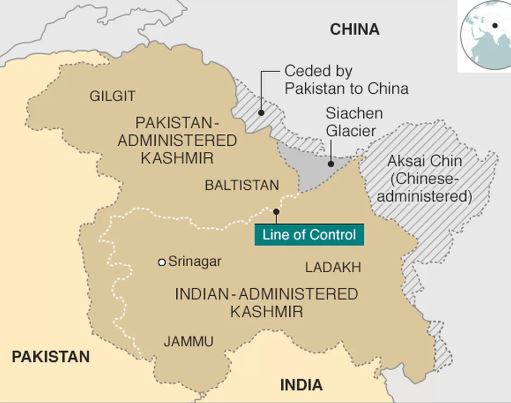
- Recently, Indian and Chinese soldiers had a heated exchange in Ladakh near the Pangong Tso lake.
- The exchange happened after Chinese Army personnel objected to patrolling by Indian soldiers.
- Differing perceptions about the ‘Line of Actual Control’ (LAC) was responsible for the incident.
- In the Ladakhi language, ‘Pangong’ means ‘Extensive concavity’, and ‘Tso’ is ‘lake’ in Tibetan.
- Pangong Tso is a long narrow, deep, landlocked lake situated at a height of more than 14,000 ft in the Ladakh Himalayas.
- The brackish water lake freezes over in winter, and becomes ideal for ice skating and polo.
- The LAC cuts through the lake, but India and China do not agree on its exact location.
- A 45 km-long western portion of the lake is in Indian control, while the rest is under China’s control.
- Most of the clashes between the two armies occur in the disputed portion of the lake.
- It lies in the path of the “Chushul”, one of the main approaches that China can use for an offensive into Indian-held territory.
- Indian assessments show that a major Chinese offensive, if it comes, will flow across both the north and south of the lake.
- Over the years, the Chinese have built motorable roads along their banks of the Pangong Tso.
- The difference in perception over where the LAC lies on the northern bank of the lake, makes this contested terrain.
- On the water, the Chinese had a major advantage earlier, but India purchased better high-speed boats.
- This leads to a quicker and more aggressive response and the induction of boats has ostensibly provoked the China.
- China started responding by increasing the number of transgressions in this area in recent years.
Source: PIB, The Indian Express


