Repo-linked deposit and lending rates
- Public Sector Banks have announced linking their lending and deposit rates to the RBI's repo rate for facilitating faster transmission.
- The RBI has been looking at various ways in which banks can be made to transmit repo rate cuts to depositors and borrowers.
- One such idea that banks have come up with is ‘repo-linked deposit and lending rates’.
- Earlier SBI linked the interest rate on its savings bank accounts as well as short-term loans to RBI’s repo rate.
- Curbing inflation or stimulating growth by raising or lowering the cost of money is the key objective of monetary policy.
- But hikes or reductions in the repo rate by RBI had only a marginal impact on the economy because of the partial transmission of these cuts by banks.
- The banks source only about 1% of their funds from RBI’s repo window and the bulk from deposits from the public,
- So it becomes difficult for the banks to slash their lending rates unless their deposit rates moderate.
- Linking savings account interest rates to the repo rate partly solves this problem.
- It ensures that banks’ cost of funds fall immediately after every repo rate cut, enabling lending rates to be pruned.
- Using an external benchmark like the repo rate makes the process more transparent to retail borrowers and depositors.
- On the flip side, both savings bank account and loan rates will swing with the repo rate.
- So both depositors and borrowers will need to brace for more volatile rates and keep a closer watch on MPC actions.
- However, Indian banks have currently linked only a part of their deposits and loans to the repo rate.
- SBI, for instance, applies it only to depositors who have a balance of over Rs 1 lakh in their savings accounts.
- This make up less than 10% of its deposit base. This is bound to lead to partial transmission.
Repo Rate
- It is the rate at which the RBI lends money to commercial banks.
- A repo rate cut allows banks to reduce interest rates for consumers on loans and lowers EMI on home loans, car loans and personal loans.
India’s economic slowdown
- Last week, RBI cut repo rates by 35 basis points, the sharpest cut in nine years.
- There is growing concern about the slowdown in India’s economic growth.
- There are two components in a economic slowdown,
- Structural or the permanent component - it is determined in the long term by factors like institutions, productivity, human capital etc.
- Cyclical or the temporary component - refers to short-term fluctuations.
- The realisation that the economy is slowing down has come late.
- The fiscal policy followed was pro-cyclical, which has only accentuated the problem.
- In a cyclical downturn, it is the fiscal policy that should have been ahead, followed by the monetary policy.
- But to such an extent the monetary policy appears to be fighting a lonely battle, neglecting fiscal policy.
- Policy prescription to increase economic growth,
- To increase household savings
- The deposit rates are declining.
- The banking system is actually recovering its losses at the cost of household savings.
- The government could have come up with savings instruments (such as infrastructure bonds).
- Structural policy misstep to be addressed
- The lowering of fiscal deficit in a cyclical slowdown would squeezes the economy further.
- Recapitalisation of public sector banks.
Perseid Meteor Shower
- The ‘Perseids’, are a prolific meteor shower which peak during mid-August, are considered the best meteor shower of the year.
- They are also known for their ‘Fireballs’ and also for their brightest Meteor Shower.
- Fireballs are larger explosions of light and color that can persist longer than an average meteor streak.
- Meteors come from leftover comet particles and bits from broken asteroids.
- When comets come around the sun, they leave a dusty trail behind them.
- Every year, from around July 17 to August 24, Earth crosses the orbital path of Comet Swift-Tuttle, the parent of the Perseid meteor shower.
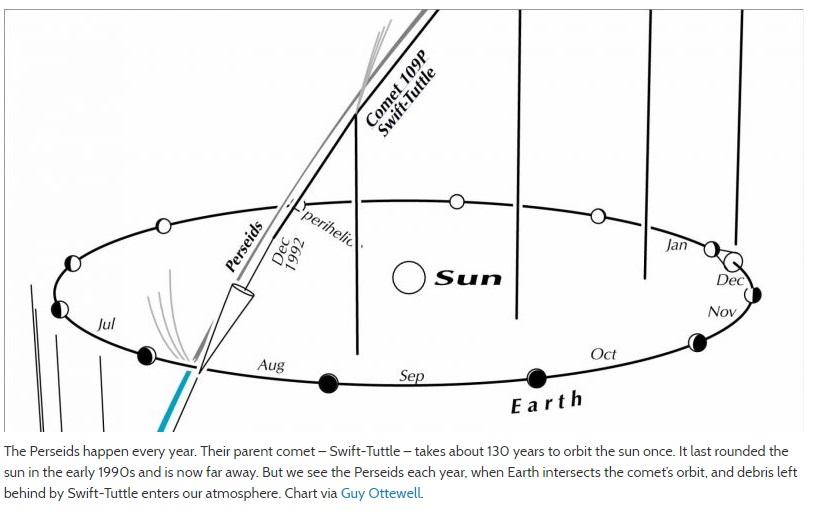
- Debris from this comet litters the comet’s orbit.
- The bits and pieces from Comet Swift-Tuttle slam into the Earth’s upper atmosphere at some 210,000 km/hour, lighting up the nighttime with fast-moving Perseid meteors.
- The Perseids currently visible in the night sky are not due to the debris left behind by the comet Swift-Tuttle during its most recent pass, which happened in 1992.
- This particular comet goes around the Sun once in 133 years.
- The meteors now visible were left behind by the pass before the last one or perhaps even earlier.
Increase of harmful Mercury level in fish
- A new study finds that Climate change is causing an increase of harmful mercury in fish.
- Climate change and over-fishing are leading to a shift in dietary patterns, pushing up the amount of toxic mercury in certain fish population.
- The Methylmercury concentrations in Atlantic cod increased by some 23% over the three decades.
- The coal power plants are the largest single manmade source of mercury pollutants.
- The carbon we release into the atmosphere has a direct correlation to the toxins that end up in our food supply.
- According to the study, a combination of 3 factors,
- 20 % reduction in methyl mercury concentration in seawater,
- 1 degree Celsius increase in ocean temperature and
- Changes in diet, can either increase or decrease the amount of methyl mercury present in fish.
- Global warming rises the seawater temperatures which makes fish need more energy to swim.
- So the fish begin to gobble up prey at a more voracious pace, result is a greater concentration of mercury in their tissue.
- The ‘Minamata Convention’ of Mercury put a ban on new mercury mines, phase-out of existing ones and strict control measures on atmospheric emission.
- There is a global efforts to reduce mercury levels in fish and other marine animals through various environmental regulations.
Source: PIB, The Indian Express


