Influenza classification
- Recently, India was again declared free of the H5N1 virus, which causes ‘avian influenza’ or ‘Bird flu’ (earlier declaration in 2017).
- WHO defines influenza as a contagious, acute respiratory illness caused by influenza viruses.
- The many kinds of viruses causing influenza are identified by a standard nomenclature issued by the WHO in 1980.
- It is of four types, A, B, C, and D.
- According to the US Centers for Disease Control and Prevention (CDC), only ‘influenza A and B viruses’ are known to cause ‘epidemics’.
- The ‘C type’ virus usually causes mild respiratory illness.
- The ‘D type’ virus typically affects cattle and is not known to infect humans.
- Influenza is known to kill 6.5 lakh people every year, especially young children, elderly, pregnant women or those with vulnerable immune systems.
- Only the ‘Influenza A virus’ is divided into subtypes, based on two proteins on the surface of the virus,
- Hemagglutinin (H) and Neuraminidase (N)
- Hemagglutinin has 18 further subtypes while
- Neuraminidase has 11.
- They are named from H1 to H18 and N1 to N11 in a sequential system.
- Humans can be infected with avian, swine and other zoonotic influenza viruses.
- Avian influenza subtypes - A(H5N1), A(H7N9) and A(H9N2).
- Swine influenza subtypesn- A(H1N1), A(H1N2) and A(H3N2).
- Novel strains of the H1N1 virus have appeared in 1918, 1957, 1968 and most recently in 2009.
- WHO designated global ‘bird flu’ outbreak in 2009 as ‘Pandemic’.
Epidemiological Terms to know
- Endemic - A disease that exists permanently in a particular geographical region or population.
- Epidemic - An infectious disease spreads rapidly to many people at about the same time.
- Pandemic - An epidemic spreads throughout the world.
- Outbreak - refers to the number of cases (disease) that exceeds what would be expected.
Vehicles Pollution test – PUC Test
- Vehicles have to undergo a ‘Pollution Under Control’ (PUC) test, in which a vehicle is certified for a certain period of time.
- The fine for PUC violations has now gone up to Rs 10,000 in the recently implemented ‘Motor Vehicles (Amendment) Act, 2019’.
- According to the Transport Department, Delhi,
- 217.7 tonnes of carbon monoxide is emitted every day by vehicles in the city.
- 84.1 tonnes of nitrogen oxides and 66.7 tonnes of hydrocarbons per day from Vehicular pollution.
- The PUC certificate is a document that any person driving a motor vehicle can be asked to produce by a police.
- The certificates are issued by authorised pollution checking centres if a vehicle is found complying with the prescribed emission norms.
- The test costs between Rs 60 and Rs 100.
- The validity of the test is 1 year for BS IV vehicles and 3 months for others.
- A PUC certificate contains information such as,
- The vehicle’s license plate number,
- PUC test reading,
- The date on which the PUC test was conducted and
- The expiry date of the certificate.
- The computerised model for pollution check was developed by the ‘Society of Indian Automobile manufacturers’ (SIAM).
Chandrayaan-2 in perspective
- The mission has not failed, although the attempt to land a spacecraft on the Moon certainly has.
- The mission comprised an orbiter, a lander and rover, the orbiter part is functioning normally.
- When ‘Vikram’ contact was lost, it was travelling at 50 to 60 m/s (180 to 200 km/hour).
- But a speed of 2 m/s (7.2 km/hr) was required for a safe landing.
- Vikram was designed to absorb the shock of an impact even at 5 m/s (18 km/hr).
- At the rate it was decelerating, it could not even have attained a speed of 5m/s before touchdown.
- It is likely to have hit the Moon at a far greater speed, possibly damaging itself and instruments on board.
- The lander has been located. It was barely a few kilometres from its pre-programmed flight path.
- ISRO eventually used the instruments on the orbiter to locate the lander.
- The orbiter has only taken a thermal image, possibly because it passed over the site at a time when there was not enough sunlight and not a normal image, which too is possible.
- The more difficult part is to restore contact with the lander.
- It would depend on how much damage it has suffered, and whether its communication unit is intact.
- Restoration of contact can be done only in the next two weeks.
- After that, the Moon will enter its night (14 Earth days).
- During which temperatures would be so cold.
- The instruments are unlikely to behave normally.
- It is possible that some of the instruments on the lander are functional.
- The instruments, if they can be revived, can possibly take readings and communicate with the ground station.
- As of now, it is unlikely that the lander is standing vertically.
- The rover could have come out of the lander only when it was standing vertically.
- It is therefore unlikely that the rover and the two instruments on it could be put to any use now.
- However, ‘Orbiter’ is functioning normally, instruments onboard will conduct most of the mission’s scientific investigations.
- Scientists insist that 80-90% of the science output of the mission have to come from orbiter.
Krishna Water dispute
- Recently, Maharashtra and Karnataka Chief Ministers jointly oppose Andhra Pradesh’s application.
- A.P seeks to relook at the Krishna Water Disputes Tribunal’s 2010 order on water distribution between the riparian states.
- This took a new turn in the Krishna water dispute.
- The Krishna is an east-flowing river that originates at Mahabaleshwar in Maharashtra.
- It flowing through Maharashtra, Karnataka, Telangana and Andhra Pradesh before entering into the Bay of Bengal.
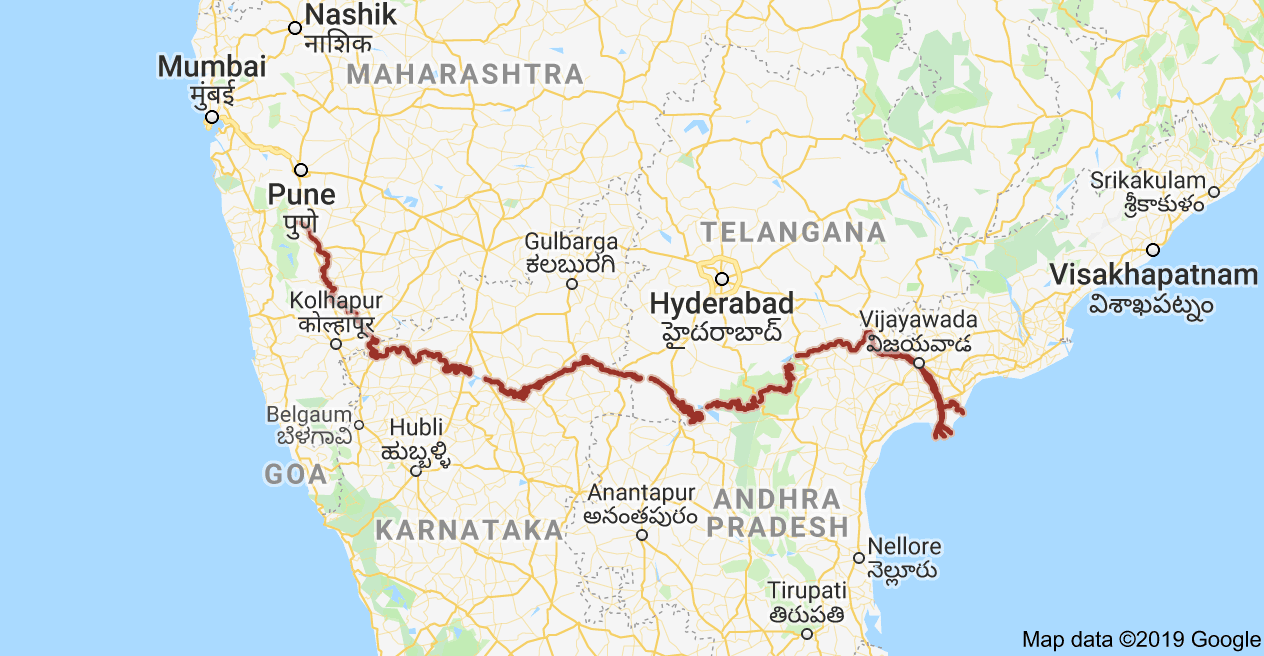
- A dispute over the sharing of Krishna waters has been ongoing for many decades.
- In 1969, the ‘Krishna Water Disputes Tribunal’ (KWDT) was set up under the Inter-State River Water Dispute Act, 1956.
- It presented its report in 1973, which was published in 1976.
- It divided the 2060 TMC of Krishna water at 75% dependability into 3 parts.
- 560 TMC for Maharashtra, 700 TMC for Karnataka and 800 TMC for Andhra Pradesh.
- It also stipulated that KWDT order may be reviewed or revised by a competent authority or tribunal any time after May 31, 2000.
- The second KWDT was instituted in 2004. It delivered its report in 2010.
- It made allocations of the Krishna water at 65% dependability and for surplus flows.
- 81 TMC for Maharashtra, 177 TMC for Karnataka, and 190 TMC for Andhra Pradesh.
- Soon after the 2010 report, Andhra Pradesh challenged it through a Special Leave Petition before the Supreme Court.
- In an order, the apex court stopped the Centre from publishing it in the official Gazette.
- In 2013, the KWDT issued a ‘further report’, which was again challenged by Andhra Pradesh in the Supreme Court.
- After the creation of Telangana in 2014, the Water Resources Ministry has been extending the duration of the KWDT.
- Andhra Pradesh has since asked that Telangana be included as a separate party at the KWDT.
- The allocation of Krishna waters be reworked among four states, instead of three.
- Maharashtra and Karnataka are now resisting this move.
- According to these 2 states, Telangana was created following bifurcation of Andhra Pradesh.
- Therefore, allocation of water should be from Andhra Pradesh’s share which was approved by the tribunal.
Source: PIB, The Indian Express


