Global Cooling Coalition
- The Global Cool Coalition is a unified front that links action across the Kigali Amendment, Paris Agreement and Sustainable Development Goals.
- The cooling coalition includes government officials from Chile, Rwanda, Denmark as well as leaders from civil society, research and academia.
- The cooling coalition is expected to inspire ambition, identify solutions and mobilize action to accelerate progress towards clean and efficient cooling.
- It is supported by the UN, the Climate and Clean Air Coalition, the Kigali Cooling Efficiency Program and Sustainable Energy for All (SEforALL).
Kigali Amendment
- In 2016, more than 170 countries agreed to amend the Montreal protocol on Substances that Deplete the Ozone Layer in Kigali/Rwanda.
- The Kigali Amendment aims for the phase-down of hydrofluorocarbons (HFCs) by cutting their production and consumption.
- Given their zero impact on the depletion of the ozone layer, HFCs are currently used as replacements of hydro chlorofluorocarbons(HCFCs) and chlorofluorocarbons (CFCs), however they are powerful greenhouse gases.
- The amendment has entered into force on 1 January 2019 with a goal to achieve over 80% reduction in HFC consumption by 2047.
- The impact of the amendment will avoid up to 0.5 °C increase in global temperature by the end of the century.
- It is a legally binding agreement between the signatory parties with non-compliance measures.
- The amendment has divided the signatory parties into three groups-
- Group I -consists of rich and developed economies like USA, UK and EU countries who will start to phase down HFCs by 2019 and reduce it to 15% of 2012 levels by 2036.
- Group II -consists of emerging economies like China, Brazil as well as some African countries who will start phase down by 2024 and reduce it to 20% of 2021 levels by 2045.
- Group III -consists of developing economies and some of the hottest climatic countries like India, Pakistan, Iran, Saudi Arabia who will start phasing down HFCs by 2028 and reduce it to 15% of 2024-2026 levels till 2047.
- The Technology and Energy Assessment Panel (TEAP) will take a periodic review of the alternative technologies and products for their energy efficiency and safety standards.
UNIDO
- UN-Industrial Development Organization (UNIDO) is the specialized agency that promotes industrial development for poverty reduction, inclusive globalization and environmental sustainability.
- The mission of UNIDO is to promote and accelerate inclusive and sustainable industrial development (ISID) in Member States.
- UNIDO is perfectly positioned to assist developing countries and countries with economy in transition to shift from HFCs to ozone- and climate-friendly alternatives and to improve energy efficiency.
Army Commanders' Conference
- Army Commanders’ Conference, chaired by Chief of the Army Staff is held biannually for formulating important policy decisions through collegiate deliberations.
- It is an important event for planning and execution process of the Indian Army.
Arctic warming
- According to recent study when the Arctic is warmer, the jet stream and other wind patterns tend to be weaker.
- Arctic warming weakens the temperature difference between the tropics and the poles, resulting in less precipitation, weaker cyclones and mid-latitude westerly wind flow, which is a recipe for prolonged droughts.
- The temperature difference between the tropics and the poles drives a lot of weather.
- When those opposite temperatures are wider, the result is more precipitation, stronger cyclones and more robust wind flow.
- However, due to the Arctic ice melting and warming up the poles, those disparate temperatures are becoming closer.
- Lakes are these natural recorders of wet and dry conditions, when lakes rise or lower it leaves geological evidence behind.
Jet Streams
- Jet streams are relatively narrow bands of strong wind in the upper levels of the atmosphere.
- On Earth, the main jet streams are located near the altitude of the tropopause and are westerly winds.
- Jet streams follow the boundaries between hot and cold air and their paths typically have a meandering shape.
- The winds blow from west to east in jet streams but the flow often shifts to the north and south.
Waterspouts
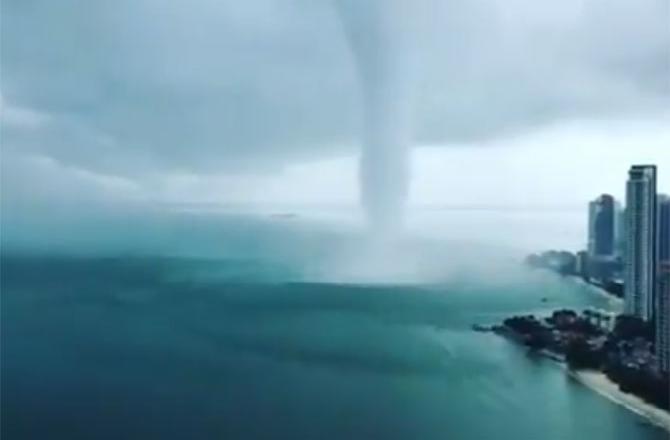
- A waterspout is an intense columnar vortex (usually appearing as a funnel-shaped cloud) that occurs over a body of water.
- Waterspouts fall into two categories
- Fair weather waterspouts - Fair weather waterspouts usually form along the dark flat base of a line of developing cumulus clouds.
- This type of waterspout is generally not associated with thunderstorms.
- A fair weather waterspout develops on the surface of the water and works its way upward.
- By the time the funnel is visible, a fair weather waterspout is near maturity.
- Fair weather waterspouts form in light wind conditions so they normally move very little.
- A fair weather waterspouts dissipate rapidly when they make landfall, and rarely penetrate far inland.
- Tornadic waterspouts - These are tornadoes that form over water, or move from land to water.
- They have the same characteristics as a land tornado and are associated with severe thunderstorms, and are often accompanied by high winds and seas, large hail, and frequent dangerous lightning.
- Tornadic waterspouts develop downward in a thunderstorm.
- If this waterspout moves onshore they may cause significant damage and injuries to people.
Source: PIB, the Hindu, Down to Earth