Apache Helicopter
- Eight US made Apache AH-64E stealth attack helicopters, has been inducted into IAF.
- The IAF has signed a contract with ‘The Boeing’ and the US government for 22 Apache attack helicopters.
- Apache is the most advanced multi-role heavy attack helicopter in the world.
- It’s modern capabilities includes, fire-and-forget, anti-tank missiles, air-to-air missiles, rockets, and other ammunition.
- Apaches has their ability to operate at much higher altitudes, unlike the aging Russian Mi-24/Mi-35 attack helicopters.
- It also has modern electronic warfare capabilities to provide versatility in network-centric aerial warfare.
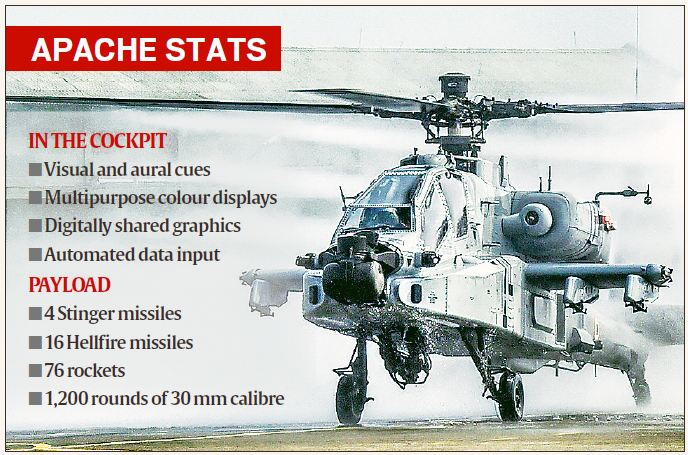
- It carry a 30 mm chain gun with 1,200 rounds as part of the area weapon subsystem.
- The helicopter carries the fire control Longbow radar, which has 360-degree coverage.
- It also has a nose-mounted sensor suite for target acquisition and night-vision systems.
- The Radar systems in the helicopter will enhance the capability of the IAF in providing integrated combat aviation cover.
- It is day/night, all weather capable, and have high agility and survivability against battle damage.
- These are easily maintainable even in field conditions, and are capable of prolonged operations in tropical and desert regions.
Asiatic Society of Mumbai
- Recently, the Asiatic Society of Mumbai, elected it’s 1st woman president (‘Prof. Vispi Balaporia’) in 215 years of its existence.
- The Asiatic Society began its journey in 1804 as the Literary Society of Bombay.
- It was founded by ‘Sir James Mackintosh’, a Scottish colonial administrator who had a keen interest in Oriental studies.
- In 1826, the Literary Society became the Mumbai arm of the London-based Royal Asiatic Society of Great Britain and Ireland.
- It came to be called the Bombay Branch of the Royal Asiatic Society (BBRAS).
- In its early days, membership of the Society was restricted to Europeans and the natives were not allowed to join until 1841.
- In 1954, the institution was severed from its London parent and became the Asiatic Society of Bombay.
- In 2002, it acquired its present name and its journal has been in publication since 1841.
- It’s activities include conducting historical research, awarding historians, and running an institute of post-graduate studies.
- It’s library, home to over 1 lakh books, consists of rare manuscripts contributed to it by the East India Company.
- It also the prized collections of,
- Original copy of Dante’s Divine Comedy and
- Coins issued by ‘Kumaragupta’ (5th century), ‘Akbar’ (16th century) and ‘Shivaji’ (17th century).
- The Society offers Junior Fellowships for research.
- It recommends scholars for the ‘Tagore National Fellowship’ of the Ministry of Culture.
- The Governor of Maharashtra is the Society’s Chief Patron.
Deflecting an Asteroid
- NASA’s DART mission, aims to deflect ‘Didymos B’, the “moonlet” of the Didymos asteroid system.
- It is an ambitious double-spacecraft mission to deflect an asteroid in space.
- It is to prove the technique as a viable method of planetary defence.
- Among all the causes that may cause extinction of life on Earth, an asteroid hit is widely acknowledged as one of the likeliest.
- The mission, includes NASA and the European Space Agency, is known as the ‘Asteroid Impact Deflection Assessment’ (AIDA).
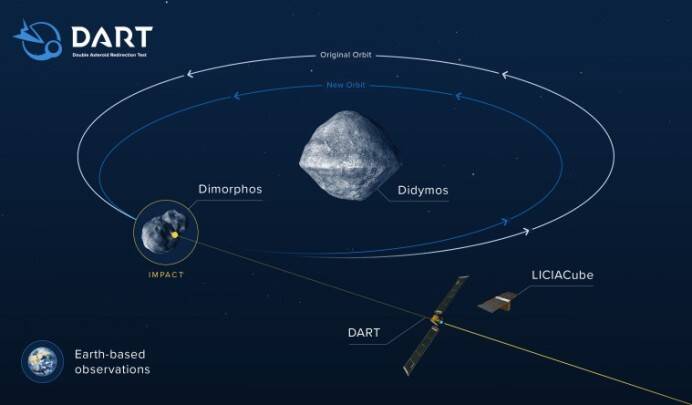
- The target is the smaller of two bodies in the “Double Didymos asteroids” that are in orbit between Earth and Mars.
- Didymos is a near-Earth asteroid system.
- Its main body measures about 780 m across, the smaller body is a “moonlet” about 160 m in diameter.
- The project aims to deflect the orbit of the smaller body through an impact by one spacecraft.
- Then a second spacecraft will survey the crash site and gather the maximum possible data on the effect of this collision.
- NASA is building the Double Asteroid Impact Test (DART) spacecraft for launch in summer 2021.
- It is planned to collide with the target at 6.6 km/s in September 2022.
- Flying along with DART will be an Italian-made miniature CubeSat, called LICIACube, to record the moment of impact.
- ESA’s contribution is a mission called ‘Hera’, which will perform a close-up survey of the post-impact asteroid.
Source: PIB, The Indian Express