Costs of wasted food to the global economy
- A new report “Reducing Food Loss and Waste” has been released by ‘World Resources Institute (WRI)’ and ‘Rockefeller Foundation’.
- It quantified that nearly one-third of the food produced each year goes uneaten, costing the global economy over $940 billion.
- The uneaten food is responsible for emitting about 8% of planet-warming greenhouse gases into the atmosphere.
- It put forward a ‘Global Action Agenda’,
- It calls on governments, companies, farmers and consumers to collectively overcome world’s food loss problem.
- Some of these actions include developing national strategies for food loss and waste reduction,
- Creating national public-private partnerships,
- Launch supply chain initiatives,
- Reducing small-holder losses and
- Shifting consumer social norms.
- According to the report most of the food loss happens,
- “Near the farm” predominantly in lower-income countries.
- “Near the plate” predominantly in higher-income countries.
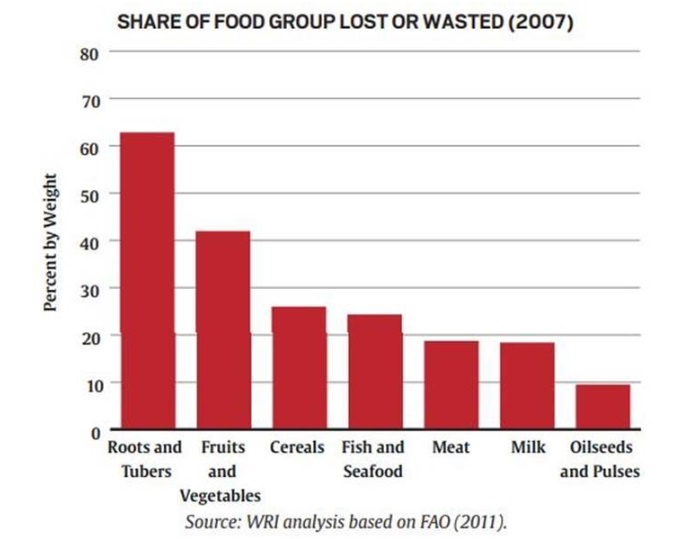
- Using FAO data of the UN, the report concluded that,
- Roots and tubers are the food group that face the maximum wastage, at over 62%.
- Fruits and vegetables follow, with over 41%.
- Fruits and vegetables make up the largest share of total annual food loss and waste as a proportion, by weight, of all the food.
India’s interim government in 1946
- On September 2, 1946, the Congress party formed the interim government led by Jawaharlal Nehru.
- It was the only cabinet in India’s history in which arch-rivals Congress and the Muslim League shared power at the Centre.
- The interim government functioned with a great degree of autonomy, and remained in power until the end of British rule.
- After which it was succeeded by the ‘Dominions of India and Pakistan’.
- Starting with Cripps mission in 1942, a number of attempts were made by colonial authorities to form an interim government.
- In 1946, elections to the Constituent Assembly were held following the proposals of the British Cabinet Mission dispatched by ‘Clement Attlee’.
- In that election, the Congress obtained a majority seats and Muslim League consolidated its support among Muslim electorate.
- ‘Viceroy Wavell’ subsequently called upon Indian representatives to join the interim government.
- A federal scheme had been visualised under the ‘Government of India Act of 1935’.
- But this component was never implemented due to the opposition from India’s princely states.
- As a result, the interim government functioned according to the older ‘Government of India Act of 1919’.
- The Muslim League initially decided to sit out of the government.
- 3 of the 5 ministries reserved for Muslims were occupied all non-League Muslim representatives and
- 2 posts remained vacant.
- However, after Lord Wavell agreed to allot all 5 reserved portfolios to the Muslim League if it agreed to cooperate, the latter finally joined.
- On September 26, 1946, Nehru declared the government’s plan to engage in direct diplomatic relations with all countries.
- In November 1946, India ratified the ‘Convention on International Civil Aviation’.
- In April 1947, the US announced the appointment of its ambassador to India.
- Embassy level diplomatic relations with the USSR and the Netherlands also started.
- After Partition was announced on June 3, a dedicated cabinet sub-committee was formed to deal with the situation on June 5.
- Later, on June 16, a special cabinet committee aimed at tackling the administrative consequences of Partition was created.
Professor Emeritus
- Jawaharlal Nehru University (JNU) has recently asked some of its Professors Emeriti, including historian Romila Thapar, for CVs to “review their position”.
- Emeritus’ (female equivalent ‘Emerita’) is a Latin word that literally means a ‘Veteran soldier’.
- Worldwide, ‘Professor Emeritus/Emerita’ is the title bestowed upon an eminent retired academic in recognition of their work and distinguished service.
- In India, the University Grants Commission (UGC) has a ‘Scheme of Emeritus Fellowship’.
- It is “to provide an opportunity to the superannuated teachers who have been actively engaged in research.
- According to the UGC, eligibility for the fellowship “will be based on the quality of research and published work contributed by the teacher in his/her service career.
- The awardee (superannuated) can work under this scheme with a well-defined time-bound action plan up to the age of 70 years or up to 2 years (non-extendable) of the award whichever is earlier.
- No extension under the scheme is admissible and hence the proposal should be well defined with a time-bound action plan.
- In JNU, the departments (called ‘centres’) propose names for Professor Emeritus.
- The JNU website currently lists 25 Professors Emeriti.
- Across the world, institutions such as the MIT, Harvard and Oxford etc. have long lists of Professors Emeriti, who are considered to add to the prestige of the university.
Source: PIB, The Indian Express


