SANKALP Scheme
- Skills Acquisition and Knowledge Awareness for Livelihood Promotion (SANKALP) project focuses on skill development.
- It is programme of ‘Ministry of Skill Development & Entrepreneurship’.
- It is an outcome oriented project supported by ‘World Bank’.
- It aims to implement the mandate of the National Skill Development Mission (NSDM).
- It focuses on district level skilling ecosystem through seamless convergence and coordination.
- It has a special focus on decentralised planning and quality improvement.
- It covers the overall skilling ecosystem of both Central & State agencies.
- Four key areas identified under the scheme are,
- Institutional Strengthening (National,State&District level)
- Quality Assurance of skill development programs
- Inclusion of marginalised population in skill development and
- Expanding Skills through Public Private Partnerships (PPPs).
- An award has also launched to promote skill planning at the district level, namely “District Skill Development Plan (DSDP) Awards”.
- The key components of this scheme are,
- National Skill Certification Body - An independent body for regulating skill assessment.
- Unified National Accreditation board – A standard registration and accreditation criteria for trainers & training centres.
- National Skill Research Division – It is an independent think tank with an objective to analyse labour markets to help make policies that suit the current trends.
- Kaushal Mart – This is a consolidated Skilling Resource Marketplace which offers a credible platform for an exchange of skilling resources.
- Takshila: National Portal for trainers – This functions as the central archive of information regarding the skill development of Trainers.
Institutions of Eminence (IoE)
- Recently UGC recommends 20 institutions for IoE.
- It is the scheme of University Grants Commission (UGC).
- Objectives of the scheme are,
- to provide for higher education leading to excellence and innovations.
- to engage in areas of specialization to make distinctive contributions to the objectives of the university education system
- to provide for high quality teaching and research and for the advancement of knowledge and its dissemination through various research programmes.
- It is expected that the selected Institutions will come up in top 500 of the world ranking in 10 years and in top 100 of the world ranking eventually overtime.
- These Institutions shall be provided with greater autonomy,
- to admit foreign students up to 30% of admitted students;
- to recruit foreign faculty upto 25% of faculty strength;
- to offer online courses upto 20% of its programmes;
- to enter into academic collaboration with top 500 in the world ranking Institutions without permission of UGC.
- The institution will get financial assistance up to Rs. 1000 Crore over the period of five years under this scheme.
Hyperloop
- It is the futuristic transportation system concept, proposed by Elon Musk.
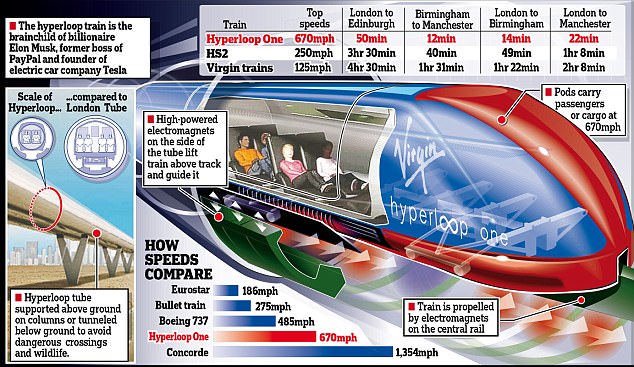
- It envisages pods or capsules travelling at high speeds through low-pressure tubes erected on columns or tunneled underground.
- The system is fully autonomous and sealed, so no driver-related error is anticipated.
- In a sealed environment with almost no air resistance, the pods are expected to reach very high speeds.
- It uses magnetic levitation, and is propelled by a proprietary electric propulsion system.
- Itd motion will not involve contact, so the vehicle will be virtually noiseless.
- It is so far only a concept with no resemblance to any public transport system known to man.
Tarballs in Mumbai’s Beaches
- Tarballs are dark-coloured, sticky balls of oil that form when crude oil floats on the ocean surface.
- They are formed by weathering of crude oil in marine environments.
- They are transported from the open sea to the shores by sea currents and waves.
- They are usually coin-sized and are found strewn on the beaches.
- However, over the years, they have become as big as basketballs and can weigh as high as 6-7 kgs.
- The presence of several tarballs indicate an oil spill.
- They can get stuck to the fishing nets installed in the sea, making it difficult for fishermen to clean.
- It could also affect marine life, especially filter feeders like clams and oysters.
- Tarball pollution is a major concern to global marine ecosystem.
- Microbes such as bacteria and fungi are known to be associated with tarballs.
- They presumably play an important role in tarball degradation and some are potential human and animal pathogens.
- They are difficult to break down, and can therefore travel for hundreds of miles in the sea.
- International Convention on Oil Pollution Preparedness, Response and Co-operation (OPRC) is an international maritime convention establishing measures for dealing with marine oil pollution.
- It aims at providing a global framework for international cooperation in combating major incidents of Marine Pollution.
- Parties to the convention are required to establish measures in dealing with pollution incidents either nationally or with other countries.
- Ships are required to carry a Shipboard Oil Emergency Plans.
Source: PIB, The Indian Expres


