School Education Quality Index
- The index is jointly released by the NITI Aayog, the Ministry of Human Resource Development, and the World Bank.
- It is to evaluate the performance of States and UTs in the school education sector.
- It assesses States based on learning outcomes, access, equity and infrastructure and facilities, using survey data, self-reported data from States and third-party verification.
- The ranking is based on 30 indicators in 2 broad categories,
- Outcomes that consisted of learning, access, infrastructure & facilities, and equity outcomes
- Governance processes aiding outcomes
- Some of the parameters are,
- The number of schools with the largest number of toilets for girl children
- The average score of students in mathematics and language in classes III, V, and VIII,
- The transition rate of students from primary to upper primary levels and also from upper primary levels to secondary level
- It used 2016-17 as the reference year and 2015-16 as the base year.
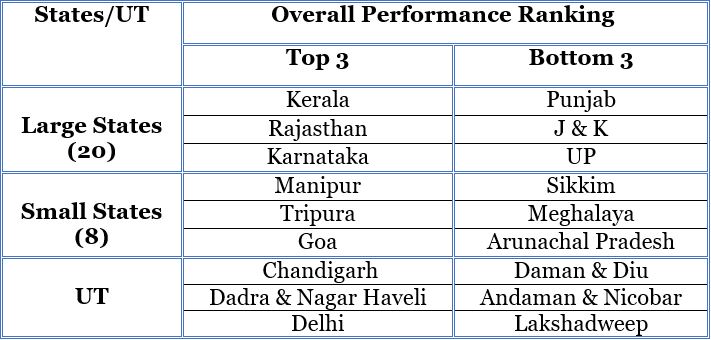
- Performance of States - Among 20 large States, Kerala was the best performer with a score of 76.6%, while Uttar Pradesh came in last with a score of 36.4%.
- Among smaller States, Manipur emerged as the best performer, while Chandigarh topped the list of UTs
- Top performers –
- Tamil Nadu was the top performer in access and equity outcomes
- Karnataka led in learning outcomes
- Haryana had the best infrastructure and facilities.
- Haryana, Assam and Uttar Pradesh showed the most improvement in their performance.
- Karnataka, along with Uttarakhand, saw the biggest drop.
- West Bengal refused to participate in the evaluation process and has not been included in the rankings.
Paleochannel
- A Paleochannel is an old or ancient channel, which are filled with younger sediments.
- It can store and transmit groundwater and therefore developed as a source of water.
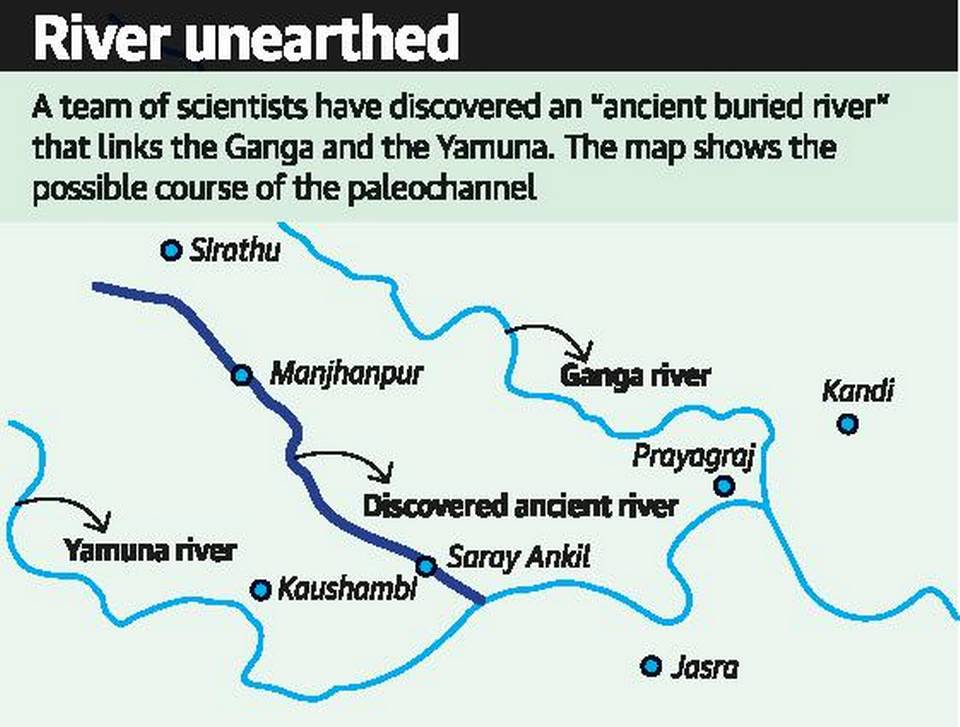
- A paleochannel in Prayagraj (formerly Allahabad) that linked the Ganga and Yamuna rivers was recently excavated.
- The aim is to develop it as a potential groundwater recharge source.
- It is around 4km wide, 45km long and consisted of a 15-metre-thick layer buried under soil.
- These paleochannels reveal the course of rivers that have ceased to exist.
- It will play a very crucial role in planning of Ganga cleaning and protecting safe groundwater resource.
- The discovery was made by a team of scientists from the CSIR-NGRI (National Geophysical Research Institute) and the Central Groundwater Board.
- The genesis of the palaeochannel’s discovery followed a 2016 report of a committee headed by K.S. Valdiya commissioned by the Water Resources Ministry.
- This report concluded that evidence from palaeochannels suggested that the mythological Saraswati river did indeed exist.
Apprenticeship Rules
- The government has notified changes in Apprenticeship Rules (1992).
- The rules envisage to increase skilled manpower in the country, and raise monetary compensation of apprentices.
- The new rules notified will come into effect from September 25.
- The Amendment Rules, 2019 seeks to raise hiring limit of apprentices to 15% of total strength of an establishment.
- The minimum amount of stipend prescribed ranges from Rs 5,000 per month for school pass outs between Class 5th and 9th.
- The stipend can be up to Rs 9,000 per month to graduate or degree apprentices in any stream.
- It has also lowered size-limit of an establishment with a mandatory obligation to engage apprentices on an optional basis from 40 to 30.
- It reduced the size-limit of an establishment wanting to engage apprentices from 6 to 4.
INS Nilgiri
- It is the first ship of the Project-17A frigates, designed indigenously by the Indian Navy.
- It has a launch weight of 2,650 tonnes with enhanced stealth features, weapons and sensors.
- It was launched at the dockyard of the Mazagon Dock Shipbuilders Limited (MDL) in Mumbai for sea trails.
- Launching is a process when a dockyard releases a warship into the sea for the first time and it undergoes various tests.
- Project-17A is a deviation from the existing Shivalik class of frigates and it incorporate new design concepts for improved survivability, sea keeping, stealth and ship manoeuvrability.
Maitree – 2019
- It is the joint military exercise between India and Thailand.
- It was recently conducted in Meghalaya.
- Its scope encompassed joint training in various facets of counter terrorism operations in urban and jungle environments.
Source: The Hindu, PIB, The Indian Express


