Prelims – Current events of national Importance | General Science.
Mains (GS III) – Science and Technology- developments and their applications and effects in everyday life.
Why in news?
Recently scientists have developed a water-based recycling solution for perovskite solar cells.
- Perovskite solar cells – A perovskite solar cell is a third-generation solar cell that employs a metal halide perovskite compound as a light absorber.
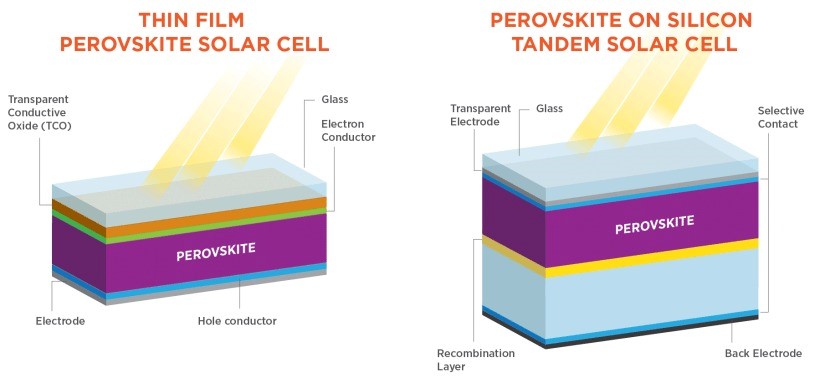
- Perovskite solar cells are made up of multiple layers.
- The perovskite layer can conduct and transport charges is sandwiched between metal electrodes and glass sheets.
- They are a class of semiconductor materials are known for their unique optical, superconductivity and electronic properties.
Metal halide perovskites (MHPs) were first discovered by Russian mineralogist L. A. Perovski.
- Advantages – They are cheaper to produce than silicon-based solar panels and offer higher efficiency in energy conversion.
- Disadvantages – But they contain toxic elements like lead that require careful disposal and have shorter lifespans than traditional solar panels.
- Perovskite materials are extremely unstable towards ambient (humidity and oxygen) conditions that restrict their commercialisation.
- Recycling – The components of the solar cells are recycled to minimize the emission and lower cost associated with solar energy generation.
- By recycling the components of a perovskite solar cell can be used for as long as possible, to minimise waste and promoting circular economy.
- Currently they are recycled using the toxic organic solvents.
The new water-based recycling process
- Dissolving and recycling the lead-containing perovskite layer in water was a major challenge to overcome.
- For this, the scientists added three key salts to help in the recycling process.
- Sodium acetate –It binds with lead ions in solar cells to form lead acetate, which is easily soluble in water.
- Sodium iodide – It helps in repairing and restoring degraded perovskite compounds.
- Hypophosphorous acid – It acts as a long-term stabilizer.
Stabilizer is a substance that either prevents or slows down reactions, thus enhancing the stability of a system.
- Ethanol and ethyl acetate solutions – They are also used to dissolve other components.
- Results of the new method – Scientists recovered approximately 99% of different layers after multiple recycling rounds.
- Recycled materials-maintained efficiency comparable to fresh materials even after five recycling cycles.
|
Quick facts
|
|
Carbon-based perovskite solar cells
- Indian scientists have indigenously developed highly stable, low-cost Carbon-based perovskite solar cells with superior thermal and moisture stability.
- The sensitivity of perovskite materials toward humidity and thermal stress is a major obstacle for practical implementation.
- Carbon-based perovskite solar cells (CPSCs) have been successful in minimizing device stability issues.
- It also reduces the fabrication costs.
|
Reference
The Hindu| Perovskite Solar Cells


