Why in news?
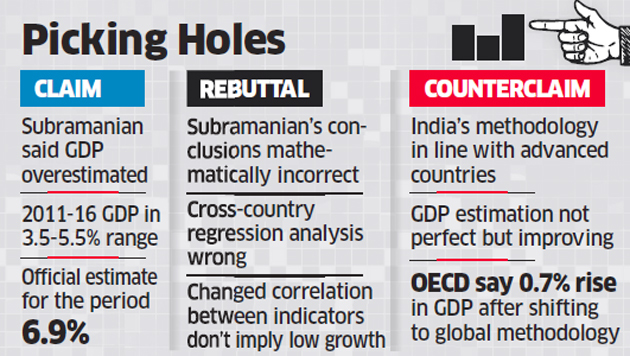
Former Chief Economic Adviser (CEA) Arvind Subramanian recently claimed in a research paper that India’s GDP growth from 2011-12 to 2016-17 was likely to have been overestimated.
What is the former CEA’s claim?
- Official estimates place average annual growth at about 7% for the 2011-12 to 2016-17 period.
- But actual growth may have been about 4.5%, with a 95% confidence interval of 3.5% to 5.5%.
- The methodological changes have led to GDP growth being overstated by about 2.5 percentage points per year between 2011-12 and 2016-17.
What were the parameters used?
- Firstly, 17 key indicators that are typically correlated with GDP growth were complied for the period 2001-02 to 2017-18.
- These include –
- electricity consumption
- two-wheeler sales, commercial vehicle sales, tractor sales
- airline passenger traffic, foreign tourist arrivals, railway freight traffic
- index of industrial production (IIP), IIP (manufacturing), IIP (consumer goods), petroleum, cement, steel
- overall real credit, real credit to industry
- exports and imports of goods and services
- Secondly, India is compared with other countries.
- For a sample of 71 high and middle income countries, relationship between a set of indicators and GDP growth for the pre and post-2011 periods was estimated.
- [The indicators chosen (credit, exports, imports and electricity) are simple, reliable, and typically not produced by the agency that estimates GDP.]
What are the key arguments?
Correlation between annual growth of indicators and GDP, 2001-2011 and 2012-2017
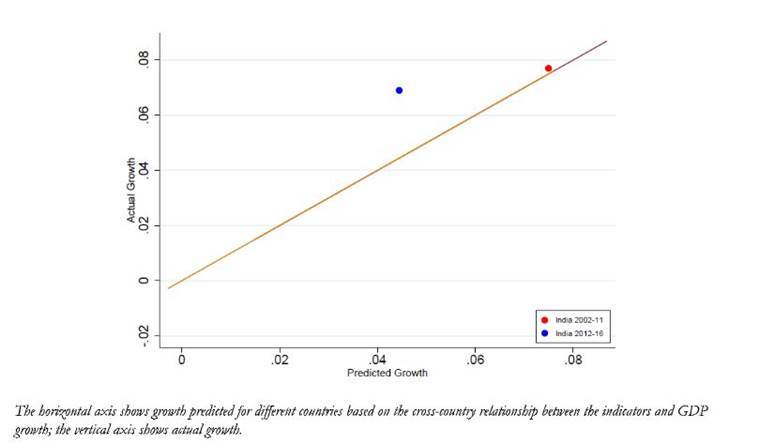
The line shows the growth predicted by the indicators (horizontal axis) and what is officially reported (vertical axis).
- Mismatch - In the first period (2001-2011), the India data point (red) is right on the line.
- This indicates that it is a normal country i.e. India’s reported GDP growth is consistent with the cross-country relationship.
- However, in the second period (2012-2017) the India data point (blue) is well above the line.
- This implies that its GDP growth is much greater than what would be predicted by the cross-country relationship.
- It is high by over 2.5 percentage points per year.
- Cause - Reproducing the detailed methodology underlying the GDP estimates is hard for outside researchers.
- So it is difficult to trace the source of the problem.
- But, possibly, one sector where the mis-measurement seems particularly severe is the formal manufacturing.
- Before 2011, formal manufacturing value added from the national income accounts moved closely with IIP (Mfg.) and with manufacturing exports.
- But afterward, the correlations turn strongly and bizarrely negative.
What was the government response?
- The government has issued a clarification refuting the claim.
- Also, the Economic Advisory Council to the Prime Minister (EAC-PM) is planning to issue a point by point rebuttal.
What are the implications of overestimation?
- Growth estimates are significant not just for reputational reasons but critically for internal policy-making as well.
- The new evidence implies that both monetary and fiscal policies over the last years were overly tight from a cyclical perspective.
- E.g. interest rates may have been too high, by as much as 150 basis points
- Also, inaccurate statistics on the economy’s health weaken the drive for reform.
- E.g. if it was known that India’s GDP growth was actually 4.5%, the urgency to act on the banking system or on agricultural challenges may have been greater
- The popular narrative has been one of “jobless growth”, hinting at a disconnect between fundamental dynamism and key outcomes.
- But in reality, weak job growth and acute financial sector stress may have been a consequence of the modest GDP growth.
What lies ahead?
- Policy discourse recently has focused on employment, agriculture and redistribution more broadly.
- But most importantly, restoring growth must be the key policy objective.
- Going forward, there must be reform urgency drawn from the new knowledge that growth has been only moderate in recent years.
- Importantly, GDP estimation in its entirety must be revisited by an independent task force.
- It should comprise of both national and international experts, statisticians, macro-economists and policy users.
- Moreover, with the current large amounts of transactions-level GST data, the revisit may, for the first time in India, help make expenditure-based estimates of GDP.
Source: Indian Express
Quick Fact
Economic Advisory Council to the PM
- Economic Advisory Council to the Prime Minister (EAC-PM) is an independent body.
- It is constituted to give advice on economic and related issues to the Government of India, specifically to the Prime Minister.
- Its functions include –
- analyzing any issue, economic or otherwise, referred to it by the Prime Minister and advising him thereon
- addressing issues of macroeconomic importance and presenting views thereon to the Prime Minister; either suo-moto or on a reference
- submitting periodic reports to the PM on macroeconomic developments and issues with implications for economic policy
- The council would attend to any other tasks as may be desired by the Prime Minister from time to time.


