What is the issue?
- Despite making significant progress in solar power generation, India still relies on China for equipment.
- In this context, here is an overview of India's solar manufacturing potentials and shortfalls.
How has the progress been in the last few years?
- The Prime Minister’s emphasis since 2014 has given a new fillip to solar power installation in India.
- India has made significant progress in creating capacity for solar energy generation in the last few years.
- The unit costs of solar power have fallen, and solar energy has become increasingly competitive with alternative sources of energy.
- India expanded its solar generation capacity 8 times from 2,650 MW in May, 2014 to over 20 GW in January, 2018, and 28.18 GW in March, 2019.
- The government had an initial target of 20 GW of solar capacity by 2022, which was achieved 4 years ahead of schedule.
- In 2015, the target was raised to 100 GW of solar capacity by 2022.
How is India's solar manufacturing potential at present?
- The supply chain of solar photovoltaic (PV) panel manufacturing is as follows:
-
- silicon production from silicates (sand)
- production of solar grade silicon ingots (blocks)
- solar wafer manufacturing
- PV module assembly
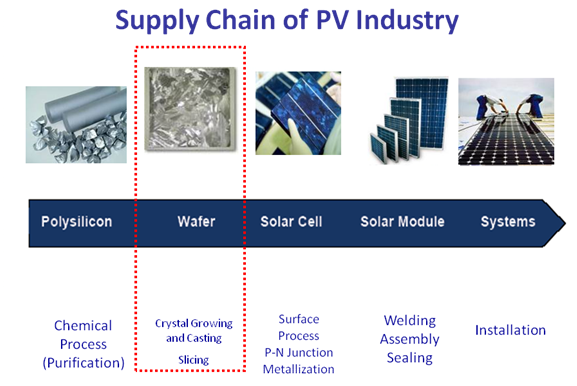
- The capital expenditure and technical know-how needed for these processes decreases from the first item to the last.
- In other words, silicon production is more capital-intensive than module assembly.
- Most Indian companies are engaged in only module assembly or wafer manufacturing and module assembly.
- No Indian company is involved in silicon production, although a few are making strides towards it.
- Clearly, India may not see domestic players, in the short term at least, replacing imported ones.
How import dependent is India yet?
- According to the Ministry of New and Renewable Energy (2018), India has an annual solar cell manufacturing capacity of about 3 GW.
- But markedly, the average annual demand is 20 GW.
- The shortfall is met by imports of solar panels.
- The government is a near monopsonistic buyer (the market condition that exists when there is one buyer) in solar sector.
- India is regarded by the global solar industry as one of the most promising markets.
- But the low-cost Chinese imports have undercut India's ambitions to develop its own solar technology suppliers.
- Imports, mostly from China, accounted for 90% of 2017 sales, up from 86% in 2014.
Why is it so?
- India is energy deficient, yet blessed with plenty of sunlight for most of the year.
- Ideally speaking, India should have taken a lead in solar panel manufacture to generate solar energy long ago, but it did not.
- So despite the new policy focus on solar plant installation, India is still not a solar panel manufacturer.
- India has no real plan in place to ensure solar panel manufacture, much like a lack of a dedicated Industrial Policy.
- [The share of all manufacturing in GDP was 16% in 1991; it remained the same in 2017.
- The solar power potential offers a manufacturing opportunity.]
What give China its edge over India?
- China’s cost advantage derives from capabilities on three fronts.
- Core competence - It takes time for companies to learn and put in action new technologies.
- When the solar industry in China began to grow, Chinese companies already possessed the know-how.
- The 6 largest Chinese manufacturers had core technical competence in semiconductors well before starting solar cells manufacturing.
- In contrast, Indian companies had no learning background in semiconductors when the solar industry in India began to grow from 2011.
- State governments need to support semiconductor production as part of a determined industrial policy to develop this capacity.
- Government policy - The Chinese government has subsidised land acquisition, raw material, labour and export, among others.
- None of this is matched by the Indian government.
- Perhaps even more important is commitment by the government to procure over the long run.
- This is crucial for investment in building up the design and manufacturing for each of the 4 stages of production of solar power equipment.
- Cost of capital - Cost of capital is another advantage for China in this regard.
- The cost of debt in India (11%) is highest in the Asia-Pacific region, while in China it is about 5%.
- Sustaining exports - In 2018, China cut financial support to developers and halted approval for new solar projects.
- As a result, Chinese producers will cut prices to sustain their manufacturing plant capacity utilisation by sustaining exports to India.
- In other words, the Chinese strategy is to undercut any planned effort by India to develop the entire supply chain capacity within India.
- It thereby ensures that dependence on imports from China continues.
What are India's efforts?
- In the solar panel manufacturing sector, the Indian government allows 100% foreign investment as equity.
- The sector also qualifies for automatic approval.
- The government is also encouraging foreign investors to set up renewable energy-based power generation projects on build-own-operate basis.
- But the Chinese government is clearly adopting an aggressive stance, exploiting India's growing demand for solar power.
- The safeguard duty on solar cells now puts locally made panels on par with imported ones in terms of cost.
- But the domestic sector needs to do a lot more to be effective.
What should India's priorities be?
- Remaining dependent on imports only leads to short-term benefits for India.
- Substituting for imports requires human capabilities, technological capabilities and capital in the form of finance.
- Making input components locally instead of importing them and putting the modules together here are essential for covering the entire supply chain.
- Public procurement should be promoted with high priority.
- The government is still free to call out bids for solar power plants with the requirement that these be made fully in India.
- This will not violate any World Trade Organization (WTO) commitment.
- However, no bids will be received as manufacturing facilities for these do not exist in the country.
- If the bids are large enough with supplies spread over years, then bidders will emerge and local manufacturing can begin.
- This is because it will give enough time for a green field investment to be made for manufacturing in India.
- In all, India needs a solar manufacturing strategy, perhaps like the Automotive Mission Plan (2006-2016).
- [The Plan is credited with making India one of the largest manufacturers of two-wheelers, three-wheelers, four-wheelers and lorries in the world.]
Source: The Hindu


