Mains Syllabus: GS II - Government policies and interventions for development in various sectors and issues arising out of their design and implementation;
GS III - Achievements of Indians in science & technology; indigenization of technology and developing new technology.
Why in the News?
Recently, the National Supercomputing Mission has been extended till December 2025.
What is the National Supercomputing Mission(NSM)?
- NSM - It is a flagship initiative by the Government of India, launched in 2015, to empower the country with high-performance computing (HPC) capabilities.
- Aim - To enhance India’s technological prowess in supercomputing, foster research and development (R&D), and support scientific advancements across academia, industry, and government sectors.
- Features - The Mission envisages empowering our national academic and R&D institutions spread over the country by installing supercomputers of various capacities.
- Nodal ministry - The Mission is being steered jointly by the Department of Science and Technology (DST) and Ministry of Electronics and Information Technology (MeitY)
- Implementing agency - Centre for Development of Advanced Computing (C-DAC), Pune and the Indian Institute of Science (IISc), Bengaluru.
- Phases of implementation
- Phase 1 - Creating a basic supercomputing infrastructure by installing six supercomputers across various institutions.
- Phase 2 - Indigenous manufacturing of supercomputers, including developing a local software stack.
- Phase 3 - Complete indigenization of supercomputing, including the design, development, and manufacturing of key components within India.
- National Knowledge Network (NKN) – Academic institutions and R&D labs are connected over a high-speed network to provide access to supercomputers.
- Academic and R&D institutions as well as key user departments/ministries would participate by using these facilities and develop applications of national relevance.
- Trinetra Network - Under the NSM, C-DAC has developed the indigenous high-speed communication network, "Trinetra," to enhance data transfer and communication between computing nodes, strengthening India’s supercomputing capabilities.
- Trinetra Phases – It is being implemented in three phases
- Trinetra-POC, a proof-of-concept system to validate key concepts
- Trinetra-A (100 Gigabits per second), a network with advanced connections, successfully deployed and tested in the 1PF PARAM Rudra at C-DAC Pune;
- Trinetra-B (200 Gigabits per second), an upgraded version with improved capabilities, set to be deployed in the upcoming 20PF PARAM Rudra supercomputer at C-DAC Bangalore.
- Rudra servers - PARAM Rudra supercomputers are built using indigenously designed and manufactured HPC servers, known as "Rudra”, along with an indigenously developed system software stack.
- “Rudra” Server is the first of its kind in India which is at par with globally available other HPC class Servers.
- Human resource development - Mission also includes development of highly professional High-Performance Computing (HPC) aware human resource for meeting challenges of development of these applications.
What is the current status of the mission?
- Current strength of super computers - Under NSM, as of March 2025, a total of 34 supercomputers with a combined compute capacity of 35 Petaflops, have been deployed across various academic institutions, research organizations, and R&D labs.
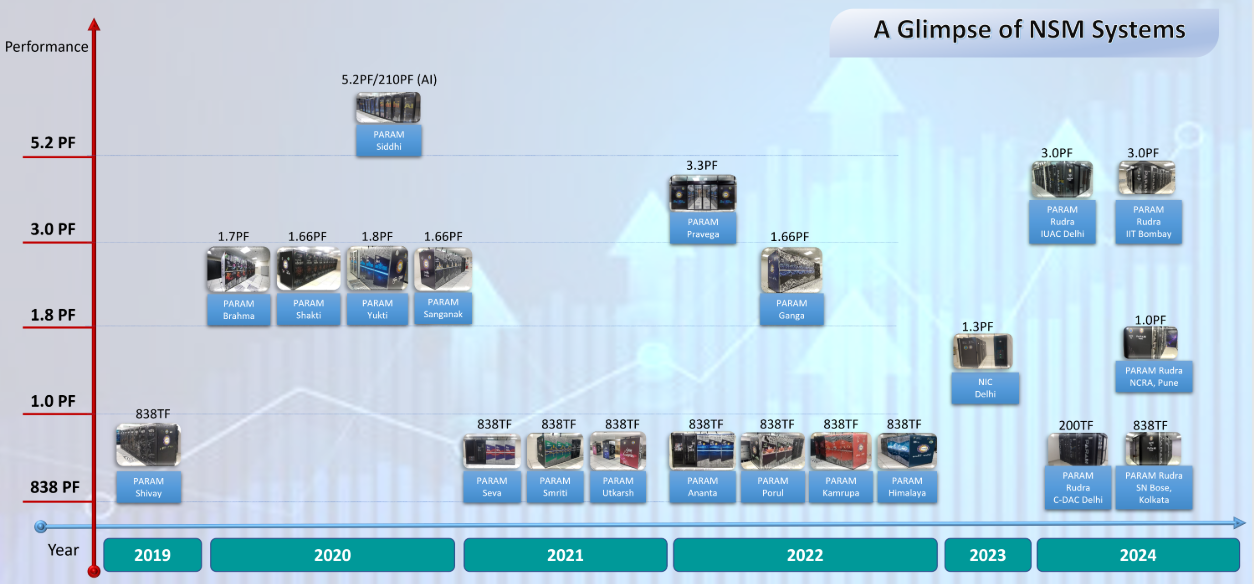
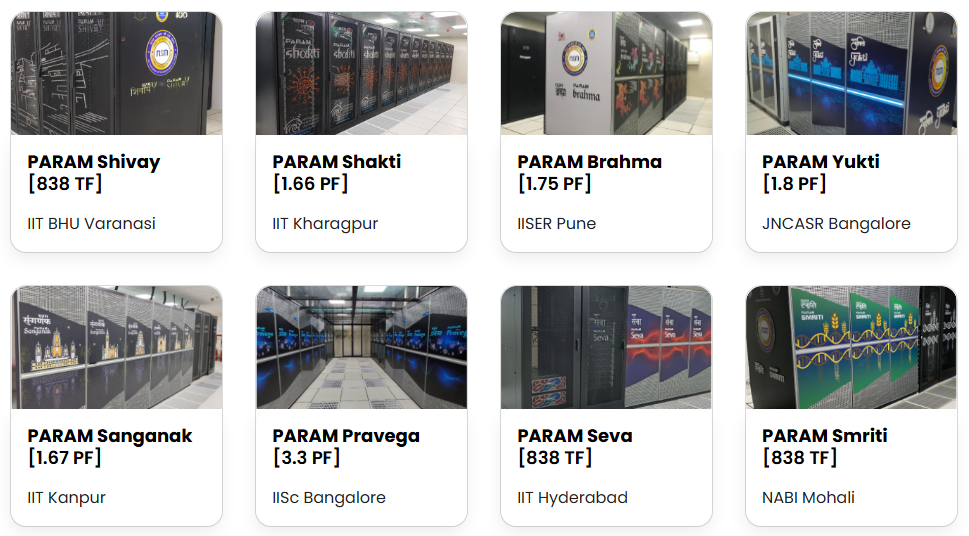
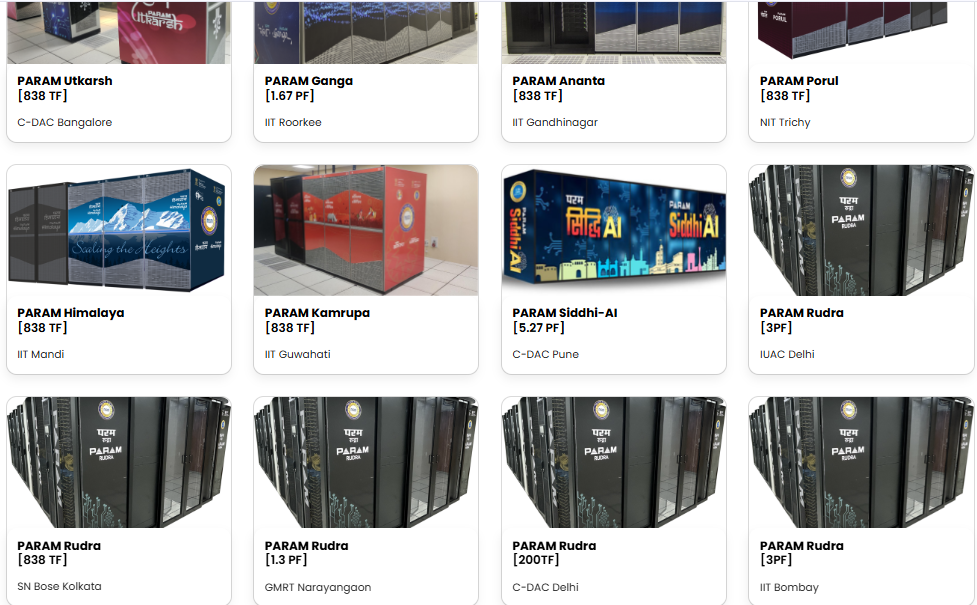
- Latest addition - In 2024, three PARAM Rudra supercomputers were dedicated to facilitate advanced studies in physics, earth sciences, and cosmology.
- Utilization rate - The supercomputing systems commissioned under NSM have achieved an overall utilization rate of over 85%, with many systems exceeding 95%, demonstrating a high level of usage and efficiency in their computational capacity.
- Applications - These supercomputing systems have supported research in critical domains such as Drug Discovery, Disaster Management, Energy Security, Climate Modeling, Astronomical Research, Computational Chemistry, Fluid Dynamics, and Material Research.
- Inclusive approach - NSM has created opportunities for researchers from Tier II and Tier III cities to conduct research by providing access to state-of-the-art supercomputing facilities.
- Start-ups and MSMEs are leveraging these supercomputing resources to advance their HPC-driven projects.
- AIRAAWAT – It is the AI supercomputer installed at C-DAC, Pune with the capacity of 13,170 teraflops.
What is the role of semiconductor mission in strengthening supercomputing mission?
- The India Semiconductor Mission (ISM) – It aims to build a strong semiconductor and display ecosystem, positioning India as a global hub for electronics manufacturing and design.
- Supporting NSM – The semiconductor mission is set to give a big boost to the National Supercomputing Mission (NSM).
- Supercomputers need powerful parts like processors, memory chips, and special accelerators — all of which are made using advanced semiconductor technology.
- Reducing import dependency - Until now, India had to rely heavily on imports for these components.
- With ISM, India is focusing on making these high-tech parts right here at home.
- Specialization - It will also allow India to build supercomputers that are customized for our own scientific and industrial needs.
- By developing these technologies within the country, ISM will help NSM move closer to its dream of making India self-reliant and a global leader in supercomputing.
What lies ahead?
- The National Supercomputing Mission is a transformative initiative that strengthens India’s position in global supercomputing.
- By fostering indigenous development, research, and innovation, NSM supports critical sectors and prepares the nation for future technological challenges.
- With continued investment and strategic deployment, India is poised to become a global leader in High-Performance Computing.
Reference
PIB | National Supercomputing Mission


