Click here to know more on the Babri Masjid controversy
Why in news?
- The Constitution Bench of the Supreme Court reserved its judgment on the Ayodhya dispute.
- The appeals were against the Allahabad High Court’s judgment on the title-suits filed by both Hindu and Muslim parties.
What is the case on?
- The Ayodhya dispute involving Hindus and Muslims dates back to 1800s.
- It relates to differences over rights to worship in Chabutra, an uncovered open platform adjoining the Babri Masjid, in Ayodhya, UP.
- The competing claims began with the surreptitious installation of Lord Ram’s idol on the night of December 22/23, 1949 under the Ayodhya structure’s central dome.
- Suits were filed over the years by both sides.
- From the 1980s, the Ayodhya dispute was used for political mobilisation by Hindu nationalist groups.
- After a court ordered the reopening of the structure’s doors in 1986, the Bharatiya Janata Party saw the scope for a national movement in it.
- The VHP (Vishva Hindu Parishad) and Bajrang Dal launched a movement for the ‘retrieval’ of the site for the construction of a grand Ram Mandir.
- With this, a dispute over title and the right of worship transformed into an uncompromising litigation based on faith.
- The disputed structure was demolished in December 1992.
- The matter was ultimately disposed of by the Allahabad High Court Bench in 2010.
- The decision involved a three-way division of the disputed area among the deity, the Nirmohi Akhara and the Muslim side.
- But, this satisfied no one and the matter went up to the Supreme Court.
- [Nirmohi Akhara is a religious denomination established by Ramananda. It is one of the litigants in the Ayodhya case.]
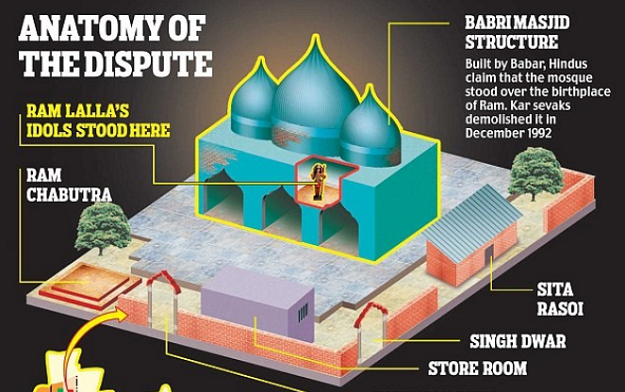
What are the challenges to the final judgement?
- Notably, the case’s emotive nature and its potential for dividing society prevented its early disposal.
- The demolition was certainly a crime against the country’s secular fabric and its constitutional ethos.
- The alleged evidence of a Hindu structure beneath the mosque came up only in excavations made after the structure was destroyed.
- Certainly, the evidence would not have been available to the court if the suits had been disposed of in earlier decades.
- So, any decision made on such evidence might amount to the judicial system legitimising the demolition.
What is the way forward?
- Given all, there can be no judicial standards to settle a faith-based argument.
- There is some talk of a “settlement” based on mediation efforts at the court’s behest.
- A mediated settlement would be welcome, even though it is not clear if all sides are on board.
- However, if the outcome is not to be based purely on the rule of law, it would be better to go for a mediated settlement.
Source: The Hindu


