Why in news?
ISRO recently announced the launch date (July 15, 2019) of Chandrayaan-2 mission, after the long delay from the scheduled launch.
Why was the delay?
- Chandrayaan-2’s predecessor, Chandrayaan-1, was an Orbiter mission which was sent way back in 2008.
- Following this, according to the original schedule, Chandrayaan-2 was to be launched in 2012 itself.
- But at that time, it was supposed to be a collaborative mission with the Russian space agency, Roskosmos, which was to provide the lander module.
- The Russians, however, withdrew from the missions.
- [This was after Russia’s similarly-designed lander for another mission developed problems in 2011.]
- This left ISRO to design, develop and build the lander on its own.
- As this was new to ISRO, it had led to considerable delay from the original schedule.
What was Chandrayaan-1 mission?
- The Chandrayaan-1 mission was ISRO’s first exploratory mission to the moon, in fact to any heavenly body in the space.
- It was designed to just orbit around the moon and make observations with the help of the instruments on board.
- The closest that Chandrayaan-1 spacecraft came to the moon was in an orbit 100 km from its surface.
- For largely symbolic reasons, though, the Chandrayaan-1 mission made one of its instruments crash-land on the moon’s surface.
- It was the Moon Impact Probe, or MIP, a 35-kg cube-shaped module with the Indian tricolour on all its sides.
- MIP left an Indian imprint on the moon’s surface.
- Besides, ISRO also claims that while on its way, MIP had sent data that showed evidence for the presence of water on the moon.
- But unfortunately, those findings could not be published because of anomalies in calibration of the data.
- [The confirmation for water had come through another onboard instrument, the M3 or Moon Mineralogy Mapper, that had been put by NASA.]
- Given the above, Chandrayaan-2 is a logical progression on Chandrayaan-1 and a more sophisticated mission with various objectives.
What are Chandrayaan-2’s features?
- Chandrayaan-2 is India’s first lander mission.
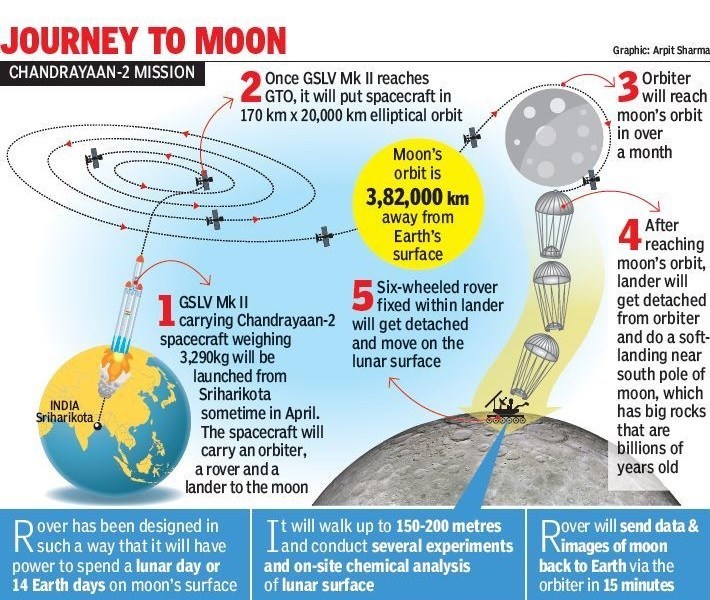
- It consists of an Orbiter, Lander and Rover, all equipped with scientific instruments to study the moon.
- The Lander and Rover modules will separate from the orbiter and make a soft-landing on moon’s surface (either on September 5 or 6, 2019).
- The lander and rover are designed to work for only 14 days (1 lunar day) while the orbiter would remain in orbit for a year.
- Orbiter - The Orbiter would once again watch the moon from a 100-km orbit.
- The Orbiter is a 2379-kg spacecraft with 7 instruments on board.
- It is equipped with different kinds of cameras to take high-resolution three-dimensional maps of the surface.
- It also has instruments to study the mineral composition on the moon and the lunar atmosphere, and to assess the abundance of water.
- The Orbiter will observe lunar surface and relay communication between Earth and the Lander.
- Lander - ISRO has named the Lander module as Vikram, after Vikram Sarabhai, the pioneer of India’s space programme.
- The 1471-kg lander will remain stationary after touching down on the moon’s surface.
- It will carry three instruments that will mainly study the moon’s atmosphere.
- One of the instruments will also look out for seismic activity on lunar surface.
- Rover - The Rover is a 6-wheeled, Artificial Intelligence-powered and solar-powered vehicle named Pragyan, meaning wisdom.
- Once on the moon, the rover will detach itself from the lander.
- Equipped with two instruments, it would slowly crawl on the surface, making observations and collecting data.
- Its primary objective is to study the composition of the moon’s surface near the landing site.
- It would also determine the abundance of different elements on the moon’s surface.
What are the challenges?
- The Lander is the distinguishing feature as this is the first time that ISRO is attempting to soft-land a module in extra-terrestrial space.
- Once the Lander and the Rover, enter the Moon’s gravity, they would be in a state of free fall.
- That could end in crash-landing and destruction of instrument.
- The main challenge is thus in controlling its speed as it approaches the surface.
- To enable a smooth landing, the speed of the Lander just ahead of touchdown should be 1 m/s (3.6 km/h) or less.
- Due to lack of air to provide drag, these instruments cannot make use of parachute-like technologies.
- So instead, the Lander fires thrusters in the opposite direction to slow down.
What is the significance?
- With Chandrayaan-2, India will become only the 4th country in the world to land a spacecraft on the moon.
- So far, all landings, human as well as non-human, on the moon have been in areas close to its equator.
- This was mainly because this area receives more sunlight that is required by the solar-powered instruments to function.
- Chandrayaan-2 will make a landing at a site where no earlier mission has gone, near the South pole of the moon.
- It is a completely unexplored territory and therefore offers great scientific opportunity for the mission to discover something new.
- [Incidentally, the crash-landing of the MIP from the Chandrayaan-1 mission had also happened in the same region.]
- South pole - The south pole of the moon holds the possibility of the presence of water.
- This is one aspect that would be probed meticulously by Chandrayaan-2.
- In addition, this area is also supposed to have ancient rocks and craters.
- It can thus offer indications of history of moon, and also contain clues to the fossil records of early solar system.
Source: Indian Express