What is the issue?
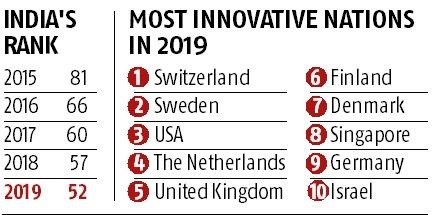
- The Global Innovation Index-2019 (GII 2019) was released recently, with India being ranked 52.
- In this context, here is how Israel converted its challenges into competitive advantages, exhibiting its intellectual prowess.
What are the highlights of GII 2019?
- The GII rankings are published every year by Cornell University, INSEAD and the UN World Intellectual Property Organization (WIPO) and GII Knowledge Partners.
- This is the 12th edition of the GII rankings of 129 economies based on 80 indicators.
- These range from intellectual property filing rates to mobile-application creation, education spending, and scientific and technical publications.
- Switzerland remains number one in the GII index followed by Sweden, USA, Netherlands, UK, Finland, Denmark, Singapore, Germany and Israel.
How is India’s performance?
- India, many believed, would break into the top 50 league for the first time. It came close, and ranked 52.
- Nevertheless, India’s performance was commended as it topped the Central and South Asian region for the 9th consecutive year.
- Also, India’s improvement from 81st rank in 2015 to 52nd in 2019 is the fastest by any major economy.
- Significantly, India also continues to outperform on innovation relative to its gross domestic product (GDP).
Why is Israel’s performance significant?
- The biggest news from the 2019 rankings was Israel breaking into the top 10 list.
- This is the first by any country from the Northern Africa and West Asia region.
What are the challenges before Israel?
- With a population of just 8.5 million, Israel has a very small domestic market.
- Israel’s enterprises cannot look at broadening its market by exporting to neighboring countries as Israel is surrounded by enemies.
- It is also endowed with very little natural resources including water.
- Its 22,000 square kilometre area is predominantly arid, fit to grow almost nothing.
How were these dealt with?
- Any other country with such adversity would have given up and become dependent on allies for survival, but Israel did not.
- Economy - Israel’s policy-makers decided early to invest in human intellectual capital and create a knowledge-based economy.
- By doing so, they hoped that Israel could become home to technology-focused industries that do not depend on natural resources.
- At the same time, the country could offer products that could be easily exported to meet the demand anywhere in the world.
- Education - Israel believed that its intellectual prowess would solve many of the pressing challenges - water scarcity, agricultural development, national security.
- Israel began by investing in a strong education system.
- Currently, it spends 7% of its GDP on education. Over 45% of its adults complete tertiary education.
- Its investment in R&D is the highest in the world (4.2% of its GDP) with a third of that going into universities.
How have these transformed into?
- Israeli universities, today, top in patent applications in the US.
- Over 250 global companies including the likes of Facebook, Google, Apple, HP and Microsoft have set up their R&D labs in Israel.
- Israel also has one of the highest concentrations of Nobel laureates.
- That apart, Israel has the largest number of hi-tech startups per capita than any other country in the world.
- Tel Aviv houses the second largest startup eco-system after Silicon Valley.
- Hi-tech exports accounts for 45% of the country’s overall exports.
- The startups have indeed solved the country’s pressing problems.
- E.g. due to their work in membrane technology, Israel has efficiently used desalination to transform itself from world’s driest country to one with surplus water
- It has become a leader in desert agriculture due to drip irrigation and precision farming.
How were the security issues dealt with?
- Israel faces security issues that come from being surrounded by enemies and constantly fighting terrorism.
- To tackle this, it invested heavily in cutting-edge technologies.
- Today, the Israeli military is a national incubator and a significant catalyst for innovation.
- With compulsory recruitment, every youth, based on talent and aptitude, gets exposed to the latest technology that the military uses.
- That apart, they are taught to work as a team and to solve problems in a structured and disciplined manner.
- These qualities help them come out and build successful enterprises.
- Check Point, the world’s largest cyber security company, is one such organisation. In fact, Israel controls as much as 10% of the global cyber security market.
How has culture contributed to this success?
- Forced to run, hide and fight in the past, Jews are natural risk-takers, an essential quality to become an entrepreneur.
- Faced with adversities, Israelis are never happy with status quo and constantly try to improve things.
- This has given birth to a trait they call ‘chutzpah’. Failure is accepted in the society and a person is encouraged to try again.
What do these hold for India?
- India too has its share of challenges when it comes to food, energy, water and national security.
- India needs to enhance sustainability and take healthcare to every nook and corner of the country; all these at a low cost.
- Like Israel, India needs to invest heavily in education and R&D.
- India’s investment in R&D now is a meager 0.7% of GDP.
- Also, very little of this goes to universities considering that a bulk of public R&D goes into space, energy and defence sectors.
- The size of the economy and population is not the constraint here, but rather the intent.
- Notably, China, another large economy, has managed to up its R&D investment from 1.3% in 2006 to 2.18% in 2018.
- India’s innovation should be focused not just on getting products and services to people at an affordable cost.
- Rather, it should be aimed for global leadership.
- Solving India’s challenges will eventually open opportunities for Indian enterprises globally, as had happened with Israel.
Source: Business Line


