What is the issue?
- The United Nations Population Fund (UNFPA) carried out population projections up to the year 2061.
- With trends showing working age population in India rising till 2040, there is an urgent need for creating enough jobs.
How is the population growth scenario?
- Population is growing, but rather on a slow pace.
- The 2011 Census revealed a notable reduction in the population growth rate.
- The percentage decennial growth during 2001-2011 registered the sharpest decline since Independence.
- For 2001-2011, the decennial growth was 17.64% which is a decrease of 3.9 percentage points from the period 1991-2001.
What does this imply?
- The percentage decline in population growth certainly implies that India has entered a low fertility era.
- The national Total Fertility Rate (TFR) [the average number of children born per woman] is 2.3.
- But the TFR in all states in India, except 7 States, has fallen below 2.1 which is the replacement level of fertility.
- [Replacement level of fertility is the TFR at which a population exactly replaces itself from one generation to the next, without migration i.e. the TFR needed to keep the population the same from generation to generation.]
- Moreover, in the 7 high fertility States too, the pace of fertility decline is fast and may soon fall below replacement level.
Will population stop growing immediately thereafter?
- Though the fertility has declined and will keep declining further, the population will keep growing for some more years.
- This is due to a phenomenon called ‘population momentum’.
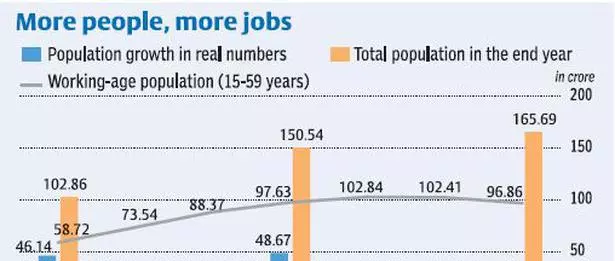
- As per the population projections by UNFPA, the peak population in India is expected to be 1,657 million (or 166 crore) around the year 2060.
- It is only after reaching this, that population growth is expected to start declining, however only slowly.
What is the working age population scenario?
- The increase in working age population (15-59 years) has been and will be higher in the near future and less and less in later years.
- Notably, India will add around 487 million people to its population between 2001 and 2031.
- There will be very little increase after that, with just 151 million in the next 30 years.
- However, during 2001-31, around 80% of the total population growth will get translated into increase in working-age population.
- Almost 390 million additional people will get added in the working-age category, which will reach a billion plus by mid-2040s.
- But after that it will start declining.
- Notably, after 2021 itself, the pressure will ease a bit, with 92 million joining during 2021-31 and 50 million during 2031-41.
- After that there will be no incremental addition to the working-age population.
What is the implication?
- The first decade of this century, 2001-11, saw addition of 150 million persons in the working-age population.
- But the number of jobs created during this period was low, resulting in unemployment or underemployment for several million people.
- Again in 2011-2021 decade, another 150 or so million people are getting added to the working-age population.
- This means that India would have to create 15 million work opportunities for these people every year.
- On top of this, there is a backlog from the first decade of this century.
What should be done?
- In all, population dynamics perspective needs to be incorporated in policy-making and programme planning.
- This is especially significant in the context of skills development and employment generation programmes.
- The needs of skilling of the young people especially will be different in different time periods and should be planned for accordingly.
- It is important that similar population analysis is undertaken at the State level for offering better employment opportunities.
Source: BusinessLine
Quick Fact
UNFPA
- UNFPA is the United Nations sexual and reproductive health agency.
- Its mission is to deliver a world where every pregnancy is wanted, every childbirth is safe and every young person's potential is fulfilled.
- UNFPA calls for the realization of reproductive rights for all.
- It thus supports access to a wide range of sexual and reproductive health services including voluntary family planning, maternal health care and comprehensive sexuality education.


