Why in news?
The second edition of NITI Aayog’s Health Index was recently released in its report titled ‘Healthy States, Progressive India: Report on Rank of States and UTs’.
What is the index on?
- The Index ranks the States and Union Territories based on 23 health-related indicators which include –
- neonatal mortality rate
- under-five mortality rate
- proportion of low birth weight among new-borns
- progress in treating tuberculosis and HIV
- full immunisation coverage
- improvements to administrative capability and public health infrastructure
- proportion of districts with functional Cardiac Care Units
- proportion of specialist positions vacant at district hospitals
- The report has ranking in three categories - larger States, smaller States and Union Territories, to ensure comparison among similar entities.
- The Health Index does not capture other related dimensions, such as non-communicable diseases, infectious diseases and mental health.
- It also does not get uniformly reliable data, especially from the growing private sector.
What are the report highlights?
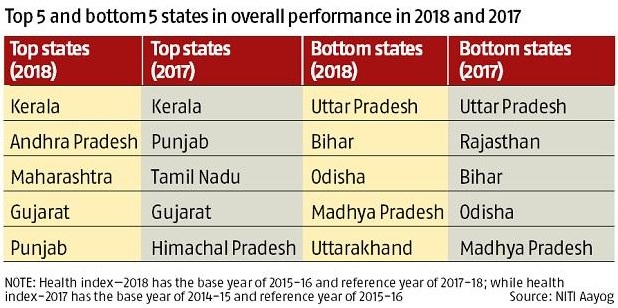
- Kerala continued to top the list for the best performing State in the health sector among the 21 large States.
- Kerala was followed by Andhra Pradesh, Maharashtra, Gujarat and Punjab, Himachal Pradesh, Jammu and Kashmir, Karnataka and Tamil Nadu.
- Andhra Pradesh and Maharashtra have had the additional distinction of making incremental progress from the base year.
- Uttar Pradesh retains the worst performer tag in the index.
- Uttar Pradesh continued to be at the bottom of the list with its score falling to 28.61; Kerala got a score of 74.01.
- Other States at the bottom of the list are Bihar (32.11), Odisha (35.97) and Madhya Pradesh (38.39).
- Among the UTs, Chandigarh jumped one spot to top the list with a score of (63.62).
- It is followed by Dadra and Nagar Haveli, Lakshadweep, Puducherry, Delhi, Andaman and Nicobar and Daman and Diu (41.66).
- Overall, only about half the States and UTs showed an improvement in the overall score between 2015-16 (base year) and 2017-18 (reference year).
- Among the 8 Empowered Action Group States, only 3 States (Rajasthan, Jharkhand and Chhattisgarh) showed improvement in the overall performance.
What does the trend imply?
- Some States and Union Territories are doing better on health and well-being even with a lower economic output.
- In contrast, others are not improving upon high standards, and some are actually slipping in their performance.
- In the assessment during 2017-18, a few large States showed less encouraging progress.
- This reflects the low priority their governments have accorded to health and human development since the first edition of the ranking for 2015-16.
- The disparities are very evident in the rankings, with the populous and politically important Uttar Pradesh being in the bottom of the list.
What is the way forward?
- For the Health Index concept to encourage States into action, public health must become part of the mainstream politics.
- The Centre has paid attention to tertiary care and reduction of out-of-pocket expenses through financial risk protection initiatives such as Ayushman Bharat.
- But several States lag behind when it comes to creating a primary health care system with well-equipped PHCs (Primary Health Centres) as the unit.
- Neglect of such a reliable primary care approach affects States such as Bihar where infant and neonatal mortality and low birth weight are high.
- Special attention is needed to raise the standards of primary care in low performing states such as Odisha, Madhya Pradesh, Uttarakhand, Rajasthan, Assam and Jharkhand.
- State governments now have greater resources at their command under the new scheme of financial devolution.
- So States, in partnership with the Centre, must use the funds to upgrade and transform the primary health care.
Source: The Hindu


