Why in news?
The 35th GST Council meeting (the first to be chaired by the new finance minister Nirmala Sitharaman) was held recently.
What are the highlights?
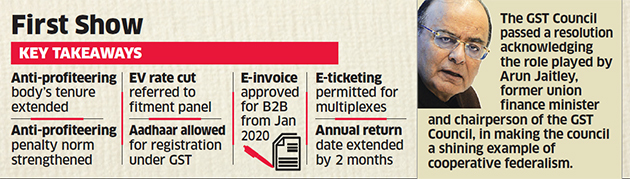
- NAA - The Council has decided to extend the tenure of National Anti-profiteering Authority (NAA) by another 2 years, till November 2021.
- It was originally scheduled to end this year. Click here to know more on National Anti-Profiteering Authority,
- The council also made the rules more stringent to enssure companies pass on the benefit of lower taxes to consumers.
- It thus approved the imposition of an additional penalty of up to 10% of the profiteered amount if companies do not pay fine in 30 days.
- At present, companies have to deposit a penalty of Rs 25,000.
- Electronic Invoicing - The council decided to introduce e-invoicing in a phased manner for business-to-business (B2B) transactions.
- E-invoicing would help tax authorities in combating the menace of tax evasion.
- Phase 1 is proposed to be voluntary and will be rolled out in January 2020.
- The council also gave in principle nod to an electronic invoicing system for companies and e-ticketing for multiplexes.
- E-tickets issued by registered multiplexes shall be deemed to be tax invoices.
- Aadhaar - Aadhaar has been approved as sufficient proof to obtain GST registration.
- Returns filing - The council extended the deadline to file annual GST returns for 2017-18 by 2 months to August 31.
- EV tax rate - Proposals to cut GST on electronic vehicles (EVs) to 5% from 12% and on electric chargers to 12% from 18% have been referred to the fitment committee.
- The issue over fixing the GST rate on leased EVs has also been assigned to the committee.
- The taxation of lotteries has been referred to the attorney general, seeking his view on the issue.
- [There has been a Calcutta High Court judgment and there is a petition before the Supreme Court in this regard.]
- Right now private and state-run lotteries face differential rates.
- A state-organised lottery attracts 12% GST while a state-authorised lottery attracts 28% tax.
- There is a dispute on whether a uniform tax rate should be imposed on lotteries or the current differential tax rate system should be continued.
- An eight-member group of state finance ministers could not reach a consensus on this.
- The attorney general will thus see if a product (being one good) can be taxed differently or not under the GST.
- GSTAT - The council decided on the location of state and area benches for the GST Appellate Tribunal (GSTAT) for various states and UTs with legislatures.
- It has been decided to have a common state bench for Sikkim, Nagaland, Manipur and Arunachal Pradesh.
How effective would NAA tenure extension be?
- The anti-profiteering system was meant to shield consumers against any sudden spike in prices after GST was rolled out in July 2017.
- This was to ensure that companies passed on savings from lower taxes to buyers.
- The NAA was earlier supposed to have a two-year sunset horizon.
- The extension of term of National Anti-profiteering Authority (NAA) now is an anticipated one.
- But it was expected that the government would come up with detailed guidelines and seek to restrict the same only in case of consumer complaints.
- Also, the industry demand for clarity on methodology for anti-profiteering has still not been addressed by the government.
- Concern - Companies should be free to respond to tax changes, in a manner determined by competitive dynamics and commercial considerations.
- The particularly complex changes such as the GST would have multiple conflicting effects on companies’ costs.
- If competitive dynamics are weak and do not allow for a proper transmission of tax cuts, then that is the concern of the Competition Commission.
- So it is anyway unfair to assume that competition would not result in passing on cost reduction from lower taxes to consumers.
- Even if a temporary authority was required in the initial years of the GST introduction, the NAA should have been wound up within its stipulated time.
- Other concerns - GST Council has missed the chance to send positive signals to boost consumer demand.
- There was no any significant cut in tax rates to help spur consumer demand that has been weak in recent quarters.
Source: Economic Times, The Hindu
Quick Facts
GST Council
- The GST Council is a constitutional body established under Article 279A of Indian Constitution.
- It makes recommendations to the Union and State Government on issues related to Goods and Services Tax.
- The Council is chaired by the Union Finance Minister.
- Its other members include the Union State Minister of Revenue or Finance, and Ministers in-charge of Finance or Taxation of all the States.
Goods and Services Tax Appellate Tribunal (GSTAT)
- GSTAT is the forum of second appeal in GST laws.
- The appeals against the orders in first appeals issued by the Appellate Authorities under the Central and State GST Acts lie before the GSTAT.
- It is the first common forum of dispute resolution between Centre and States.
- Chapter XVIII of the Central GST Act provides for the Appeal and Review Mechanism for dispute resolution under the GST Regime.
- It empowers the Central Government to constitute, on the recommendation of Council, an Appellate Tribunal.
Fitment Committee
- The rate fitment committee comprises of tax officials of the central and state governments.
- Its task is to evolve a principle and an appropriate methodology to determine rates for various supplies under GST.
Related News: Concerns with Anti-Profiteering Authority


