What is the issue?
- Some stricter measures to fight air pollution will come into force in Delhi’s neighbourhood starting October 15 2019, as part of the Graded Response Action Plan (GRAP).
- In this backdrop, here is an overview of the Graded Response Action Plan (GRAP).
What are the recent pollution control measures?
- In 2018, the ban on using diesel generator sets was implemented only in Delhi. In the current year (2019), it is being extended to a few NCR towns.
- Notably, many areas here see regular power cuts.
- Rural areas are, however, being left out of this stringent measure because of unreliable power supply.
- The measures that are coming into force will be incremental.
- As pollution rises, and it is expected to rise as winter approaches, more measures will come into play depending on the air quality.
- All these measures are part of the Graded Response Action Plan (GRAP) that has been in effect for 2 years in Delhi and the National Capital Region (NCR).
What is GRAP?
- The GRAP was formulated in 2016 and approved by the Supreme Court in the same year.
- It was notified in 2017 by the Centre, and draws its authority from this notification.
- It was planned after several meetings of EPCA (Environment Pollution (Prevention and Control) Authority) with state government officials and experts.
- GRAP institutionalised the measures to be taken when air quality deteriorates.
- It aims to roll out progressively tougher actions as pollution levels rise, without waiting for an emergency to impose strict measures.
How does GRAP work?
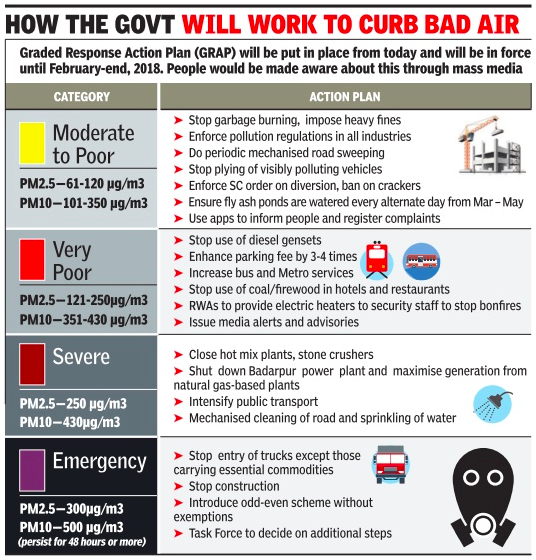
- The plan is incremental in nature.
- So, it does not include action by various state governments to be taken throughout the year to tackle emissions.
- Rather, when the air quality shifts from poor to very poor, the measures listed have to be followed.
- If air quality reaches the severe stage, GRAP talks about shutting down schools and implementing the odd-even road-space rationing scheme.
- The plan requires action and coordination among 13 different agencies in Delhi, Uttar Pradesh, Haryana and Rajasthan (NCR areas).
- At the top is the EPCA, mandated by the Supreme Court.
- Before the imposition of any measure, EPCA holds a meeting with representatives from all NCR states.
- A call is taken on which actions have to be made applicable in which town.
How effective has GRAP been?
- GRAP has been successful in doing two things that had not been done before -
- creating a step-by-step plan for the entire Delhi-NCR region
- getting on board several agencies: all pollution control boards, industrial area authorities, municipal corporations, regional officials of IMD and others
- The biggest success of GRAP has been in fixing accountability and deadlines.
- For each action to be taken under a particular air quality category, executing agencies are clearly marked.
- In a territory like Delhi, where a multiplicity of authorities has been a long-standing impediment to effective governance, this step made a crucial difference.
- Clear demarcation of responsibilities has made easier the coordination among as many as 13 agencies from 4 states.
- Three major policy decisions that can be credited to EPCA and GRAP are-
- the closure of the thermal power plant at Badarpur
- bringing BS-VI fuel to Delhi before the deadline set initially
- the ban on Pet coke as a fuel in Delhi NCR
What are the shortfalls?
- A major concern with the EPCA and the GRAP has been the focus on Delhi.
- Delhi has always been the first one to have stringent measures enforced.
- Other states have managed to delay several measures, citing lack of resources.
- For GRAP as well as EPCA, the next challenge is to extend the measures to other states effectively.
Source: Indian Express
Quick Fact
EPCA
- The EPCA, headed by retired IAS officer Bhure Lal and including members from the Centre for Science and Environment, was constituted in 1998 by the Supreme Court.
- The initial mandate of the body was to ensure the shift of Delhi’s bus and auto fleet to CNG.
- The body continues to monitor pollution and assists the Supreme Court in several pollution-related matters.


