Why in news?
India has reduced its poverty rate from 55% to 28% in 10 years according to a new version of the global Multidimensional Poverty Index (MPI) report 2018.
What is the report on?
- It was developed by the United Nations Development Programme (UNDP) and the Oxford Poverty and Human Development Initiative (OPHI).
- MPI is a measure that takes into account the incidence of poverty and the extent of deprivation i.e. “who is poor” and “how they are poor”.
- MPI is thus the product of two measures -
- poverty rate as a percentage of the population
- poverty intensity as the average share of deprivations that poor people experience
- The index is based on a list of 10 deprivations for poor, covering health facilities, education and living standards.
- If someone is deprived in a third or more of the 10 weighted indicators, the global index identifies them as “MPI poor”.
- The present report covers 105 countries which are home to 77% of the world’s population or 5.7 billion people.
- The report dedicates a chapter to India because of its remarkable progress.
What is India's poverty scenario?
- Nearly 271 million people have moved out of poverty between 2005-06 and 2015-16 in India.
- India still had 364 million poor in 2015-16, the largest for any country. Nevertheless, it is down from 635 million in 2005-06.
- A total of 113 million people, or 8.6% of India’s people, live in 'severe poverty'.
- The traditional disadvantaged sub-groups such as rural dwellers, lower castes and tribes, Muslims and young children are still the poorest.
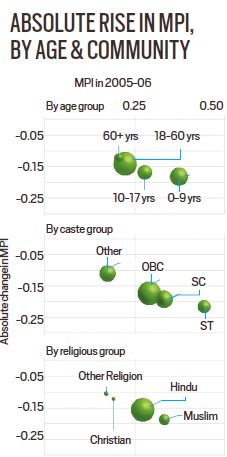
- Nevertheless, the rate of poverty reduction among children, the poorest states, Scheduled Tribes, and Muslims was the fastest.
- Children - Of the 364 million people who were MPI poor in 2015-16, 156 million (34.6%) were children.
- This is a 47% decrease from the 292 million poor children in India in 2005-06.
- Multidimensional poverty among children under 10 years of age has fallen the fastest.
- So the latest figures represent that 136 million fewer children are growing up in multidimensional poverty than in 2005-06.
- However, two in five children under 10 years of age are poor (41%), but less than one quarter of people aged 18 to 60 (24%) are poor.
- STs - Although Muslims and STs reduced poverty the most over the 10 years, these two groups still had the highest rates of poverty.
- While 80% of ST members had been poor in 2005-06, 50% of them were still poor in 2015-16.
- On the other hand, only 15% of the higher castes are poor.
- Muslims - While 60% of Muslims had been poor in 2005-06, 31% of them were still poor in 2015-16.
- Every third Muslim is multidimensionally poor, compared to every sixth Christian.
- States - The four poorest states are Bihar, Jharkhand, Uttar Pradesh, and Madhya Pradesh.
- These are still home to 196 million MPI poor people, which is over half of all the MPI poor people in India.
- Bihar was the poorest state in 2015-16, with more than half its population in poverty.
- Across the 640 districts in India, the poorest district is Alirajpur in Madhya Pradesh, where 76.5% of people are MPI poor.
- Jharkhand had the greatest improvement, followed by Arunachal Pradesh, Bihar, Chhattisgarh, and Nagaland.
- At the other end, Kerala, one of the least poor regions in 2006, reduced its MPI by around 92%.
How is it globally?
- Worldwide, 1.3 billion (23%) people live in multidimensional poverty in the 105 developing countries that the report covered.
- This represents 23%, or nearly a quarter, of the population of these countries.
- Regions - Multidimensional poverty was found in all developing regions of the world.
- However, it was seen to be particularly acute in Sub-Saharan Africa and South Asia.
- These two regions account together for 83% (more than 1.1 billion) of all multi-dimensionally poor people in the world.
- Additionally, two-thirds of all multi-dimensionally poor people live in middle-income countries.
- Nearly 889 million people in these countries experience deprivations in nutrition, schooling, and sanitation, just like those in low-income countries.
- Children - Children account for almost half (49.9%) of the world’s poor.
- Worldwide, over 665 million children live in multidimensional poverty.
- In 35 countries, at least half of all children are MPI poor.
- In South Sudan and Niger, some 93% of all children are MPI poor.
Source: Indian Express


