Prelims: Economic Geography of India | Agriculture
Why in News?
In last few decades times, both rice and wheat acreages across India was rising than other crops.
- Reason for preferences - The most primary reason for expansion in rice and wheat area is the government’s near-guaranteed purchases of the 2 crops at minimum support prices (MSP).
- This kind of government backstop does not exist for other crops, discouraging their cultivation.
- For instance, Punjab’s cotton area has plunged from 3.4 lh in 2015-16 to one lh in 2024-25 and in Madhya Pradesh.
- They are being grown largely under irrigated conditions.
- They also receive priority with regard to public breeding and research support.
- Cotton has seen no new breeding breakthroughs after the genetically modified (GM) Bt cotton hybrids commercialised during 2002-06.
- Recently, Indian Council of Agricultural Research (ICAR) unveiled a genetically-edited (GE) mutant line of a rice & wheat.
- Being non-lodging made them more responsive to fertiliser and water application.
- They both have relatively lesser yield risk than other crops.
- For example, yields in most oilseeds, pulses and other field crops have been flat or registered modest increases
- The 1st generation of Green Revolution wheat varieties such as Kalyan Sona and Sonalika, released in the late-1960s, yielded an average 3.8 tonnes of grain per hectare under normal growing conditions in farmers’ fields
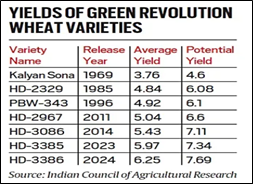
- These wheat varieties were bred for not only higher yields, but also for resistance against rust diseases (caused by fungal pathogens) and climate-smart traits.
The HD-3385 variety of wheat released in 2023, for example, yields an average of 6 tonnes per hectare and potential of over 7.3 tonnes. It is, moreover, resistant to all major rusts – yellow (stripe), black (stem) and brown (leaf).
Quick Facts
|
|
Genome Edited Rice
|
Genome Edited Wheat
|
|
Variety
|
Pusa DST Rice 1
|
Kamala
|
|
Parent
|
Cottondora Sannalu (MTU-1010)
|
Samba Mahsuri
|
|
Edited
gene
|
DST (drought and salt tolerance) gene, reducing its expression
|
Gn1a’ gene - to reduce its expression
|
|
Effect
|
It becomes viable even under conditions of water, salinity and alkalinity stress.
|
It promotes cytokinin accumulation, leading to higher grain numbers.
|
- Cytokinins - They are plant hormones that help increase the number of grains per panicle.
- DST (drought and salt tolerance) gene - It acts as a negative regulator, inhibiting the rice plant’s tolerance to abiotic stresses such as heat and salinity.
Reference
The Indian Express| Preference for Rice and Wheat Cropping in India


