Why in news?
The oil prices of West Texas Intermediate (WTI), the best quality of crude oil in the world, fell to “minus” $40.32 a barrel in New York, US.
What is the key reason?
- Even before the Covid-19 induced global lockdown, crude oil prices had been falling over the past few months.
- They were closer to $60 a barrel at the start of 2020 and by March-end, they were closer to $20 a barrel.
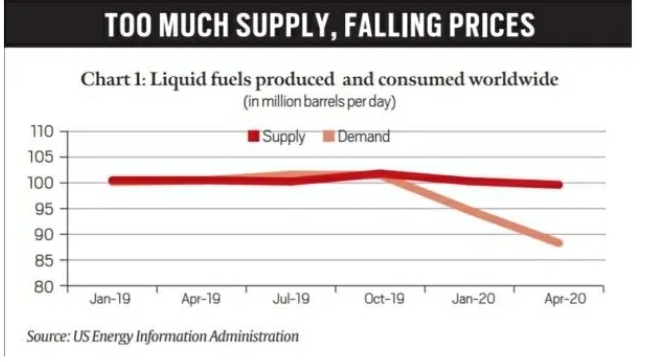
- To a great extent, oil markets, globally and more so in the US, are facing an enormous glut.
- Certainly, the price fall is thus a result of the supply being more than the demand.
- [This is not only the lowest crude oil price ever known but also well below the zero-mark. The previous lowest was said to be immediately after World War II.]
What are the other recent developments?
- Historically, the Organization of the Petroleum Exporting Countries (OPEC) used to work as a cartel and fix prices in a favourable band.
- [The OPEC is lead by Saudi Arabia, the largest exporter of crude oil in the world (single-handedly exporting 10% of the global demand).]
- It could bring down prices by increasing oil production and raise prices by cutting production.
- In the recent past, the OPEC has been working with Russia, as OPEC+, to fix the global prices and supply.
- But in early March 2020, this cooperation that is crucial for the global oil market's seamless operations came to an end.
- Saudi Arabia and Russia disagreed over the production cuts required to keep prices stable.
- As a result, oil-exporting countries, led by Saudi Arabia, started undercutting each other on price.
- However, they continued to produce the same quantities of oil.
- The Saudi Arabia and Russia discord was sorted out recently, under pressure from US President Donald Trump.
- However, it was too late.
- The oil-exporting countries decided to cut production by 6 million barrels a day, the highest production cuts.
- But, the demand for oil has been shrinking by 9 to 10 million barrels a day.
- This was an unsustainable strategy under normal circumstances.
- The growing spread of Coronavirus made it even more calamitous.
How has the lockdown worsened the situation?
- Given the lockdown condition, there is a sharp reduction in economic activity.
- With fewer flights and fewer cars, the demand for oil has been shrinking (9 to 10 million barrels a day).
- The supply-demand mismatch continued to worsen right through March and April 2020.
- The mismatch resulted in almost all storage capacity being exhausted.
- Trains and ships, which were typically used to transport oil, too, were used up just for storing oil.
What is the immediate cause?
- The May contracts for WTI, the American crude oil variant, were due to expire on April 21, 2020.
- As the deadline came near, prices started reducing, for two broad reasons.
- By April 2o, 2020, many oil producers wanted to get rid of their oil even at unbelievably low prices.
- The other unattractive option was to shut production, which would have been much more costly to restart.
- The consumer side that is those holding these contracts could not go by the compulsion to buy more oil.
- This is because there was no space to store the oil if they were to take the delivery.
- It would be more costly for them to accept the oil delivery, pay for its transportation and then pay for storing it (possibly for a longer period).
- This desperation from both sides - buyers and sellers - to get rid of oil led to the present condition.
- In the short-term, for both the contract holders and the oil producers, it was less costly to pay $40 a barrel, and get rid of the oil.
- [This means the seller would be paying the buyer of crude oil $40 for each barrel.]
- All this meant that the oil prices not only dropped to zero but also went deep into the negative territory.
How does the future look?
- It is important to note that it was the WTI price for May 2020 in the US markets that went so low.
- Crude oil prices elsewhere fell but by not so much.
- Moreover, at least for now, oil prices for June 2020 are pegged at around $20 a barrel.
- It is likely that the WTI price was a one-off event and will not happen as producers are forced to cut back production further.
- However, there is still uncertainty given the continuing spread of Covid-19 and the demand falling every day.
- In all, it would be the demand-supply mismatch (adjusted for storage capacity) that will decide the fate of oil prices in the coming days.
Source: Indian Express


