What is the issue?
- Leaders from the BIMSTEC, Kyrgyz Republic and Mauritius are invited for the swearing-in ceremony of Indian Prime Minister.
- In this context, here is an overview on the role and significance of BIMSTEC in India.
What do these imply?
- BIMSTEC (Bay of Bengal Initiative for Multi-Sectoral Technical and Economic Cooperation) - The invite signals a major outreach to India’s neighbourhood in the Bay of Bengal.
- Last time, the PM had invited the SAARC leaders.
- The then Pakistan Prime Minister Nawaz Sharif’s attendance had raised hopes of a new beginning in the bilateral ties.
- This time, SAARC’s exclusion is clearly aimed at keeping Pakistan out of New Delhi’s engagement with its neighbours.
- Kyrgyzstan - By inviting the Kyrgyz Republic leader, India is displaying an outreach to the Shanghai Cooperation Organisation (SCO).
- India became a member in SCO along with Pakistan in 2017.
- India thus wants to leverage its membership to advance its strategic objectives in Central Asia.
- Mauritius Prime Minister Pravind Jugnauth is one of the most well-placed People of Indian Origin in the world.
- Since Indian PM has invested diplomatic capital in outreach to the Indian diaspora since 2014, this invite is seen as a natural choice.
Why is BIMSTEC so significant?
- BIMSTEC comprises of Bangladesh, Myanmar, Sri Lanka, Thailand, Nepal and Bhutan, besides India.
- New Delhi’s engagement with BIMSTEC rose from the ashes of SAARC (India, Pakistan, Bangladesh, Bhutan, Sri Lanka, Maldives, Nepal, and Afghanistan).
- In October 2016, following the Uri attack, India gave a renewed push for BIMSTEC, although it had existed for almost two decades.
- India had long felt that the vast potential of SAARC was being under-utilised.
- Opportunities were being lost due to either a lack of response and/or an obstructionist approach from Pakistan.
- So BIMSTEC had emerged as an alternative regional platform.
- With 5 five countries from SAARC and two from ASEAN, BIMSTEC is a bridge between South Asia and Southeast Asia.
- It thus offers scope for discussions on sub-regional cooperation.
- Nevertheless, SAARC summit has only been postponed, and not cancelled.
- The possibility of revival remains, and so, the success of BIMSTEC does not render SAARC pointless.
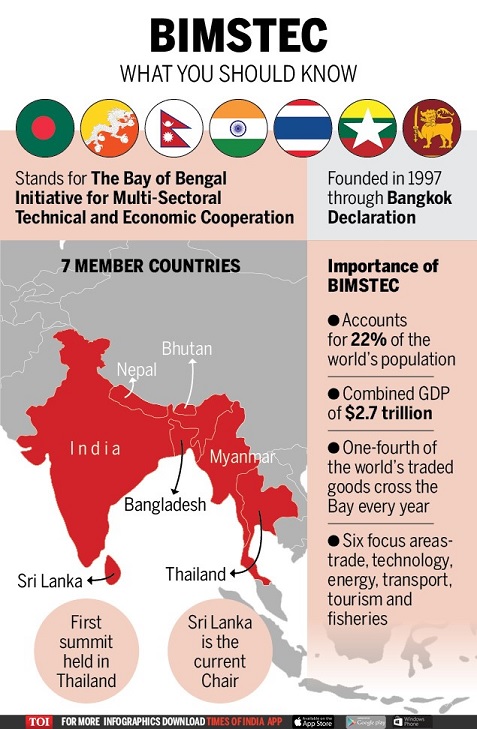
Why the region matters?
- The Bay of Bengal is the largest bay in the world.
- Over one-fifth (22%) of the world’s population live in the seven countries around it.
- These countries have a combined GDP of close to $2.7 trillion.
- Despite economic challenges, they have been able to sustain average annual economic growth rates of 3.4% - 7.5% from 2012 to 2016.
- The Bay also has vast untapped natural resources.
- One-fourth of the world’s traded goods cross the Bay every year.
How could India benefit?
- As the region’s largest economy, India has a lot at stake in BIMSTEC.
- It is a natural platform to fulfil India's key foreign policy priorities of ‘Neighbourhood First’ and ‘Act East’.
- A key reason for India's engagement is the vast potential that is unlocked with stronger connectivity.
- About 45 million people live in landlocked North-eastern states.
- They will have the opportunity to connect via the Bay of Bengal to Bangladesh, Myanmar and Thailand.
- This opens up new possibilities in terms of development.
- From the strategic perspective, the Bay of Bengal is a funnel to the Malacca straits.
- In this context, the Bay has emerged a key theatre for an increasingly assertive China in maintaining its access route to the Indian Ocean.
- Given these, it is in India’s interest to consolidate its internal engagement among the BIMSTEC countries.
- The BIMSTEC invite is an effort to reach out diplomatically to the neighbourhood, diaspora and the China-Russia-led regional grouping of Central Asian countries.
- The future course of the move depends on the progress New Delhi makes with these groupings.
Source: Indian Express


