Mains Syllabus: GS III - Environmental pollution and degradation.
Why in the News?
South Korean tech giants LG and Samsung have filed legal petitions against the Indian government, challenging a newly introduced e-waste recycling regulation that mandates a minimum payout to recyclers.
What is the status of e-waste in India?
- E Waste - Electronic waste is the discarded electrical and electronic equipment and its parts, often containing toxic materials.
- It includes items like computers, mobile phones, and household appliances that have reached the end of their useful life and are discarded.
- Composition - E-waste contains a variety of materials, including precious metals like gold and copper, as well as hazardous substances like mercury, lead, and cadmium.
- Solid Waste - Electronic waste (e-waste) is one of the fastest growing solid waste streams in the world.
- E waste Generation Rate - In 2022, an estimated 62 million tonnes of e-waste were produced globally , up 82% from 2010 but Only 22.3% was documented as formally collected and recycled.
- The world’s generation of electronic waste is rising five times faster than documented e-waste recycling, reports the UN’s fourth Global E-waste Monitor (GEM).
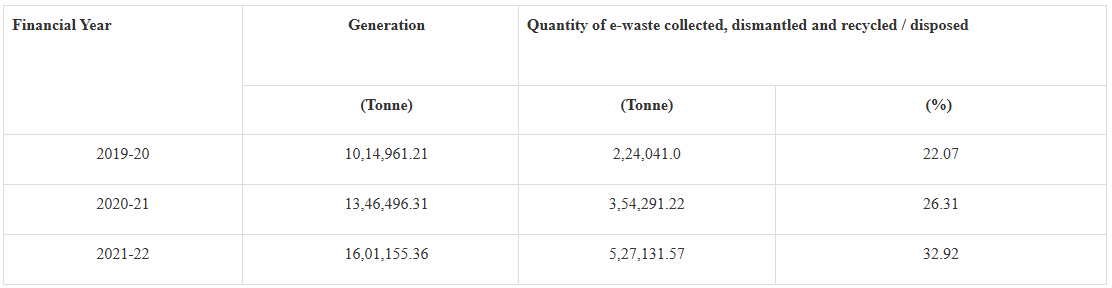
- India’s E waste Generation - India's e-waste generation surged by 73% in five years, reaching 1.751 million MT in 2023-24.
India ranks as the world’s third-largest generator of electronic waste, after China and the United States.
What are the impacts of e-waste?
- Soil and Water Contamination - E-waste contains toxic substances like lead, mercury, cadmium that can leach into the soil and water when disposed of improperly.
- Air Pollution - Burning or improper shredding of e-waste releases harmful pollutants into the air, like dioxins, furans, and particulate matter,contributing to air quality degradation.
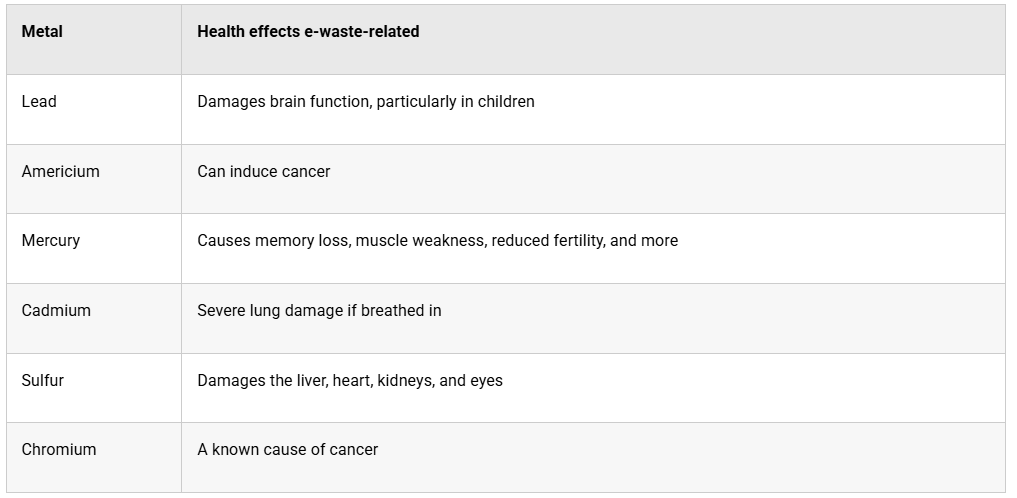
- Health Problem - Exposure to the harmful chemicals from e-waste creates severe health hazards that can be fatal.
- The toxins enter our bodies through inhalation, ingestion of food or water, and skin absorption.
- Climate Change - The decomposition of e-waste in landfills and incineration of e-waste produces greenhouse gases like methane, a potent greenhouse gas, which contribute to climate change.
- Biodiversity Loss - Pollution caused by e-waste impacts some animal species more than others, which may be endangering these species and the biodiversity of certain regions that are chronically polluted.
- Economic Losses - The improper disposal of valuable materials in e-waste results in a loss of resources and economic opportunities.
India loses more than $10 billion annually due to water pollution from the disposal of cyanide and sulphuric acid solutions, air pollution caused by lead fumes, open coal burning, and plastic incineration, and soil pollution.
|
E- Waste regulations in India
|
- The management of E-Waste in India is presently regulated under E-Waste (Management) Rules, 2022 under the Environment Protection Act, 1986 and notified by Central Pollution Control Board.
- Extended Producer Responsibility – The EPR mandates that producers of Electrical and Electronic Equipments are responsible for the entire lifecycle of their products, including post-consumer waste management.
- This responsibility encompasses the collection, recycling, and environmentally sound disposal of e-waste.
- Rules Applicability - It apply to every manufacturer, producer, refurbisher, dismantler, and recycler involved in the lifecycle of EEE listed in Schedule I.
- Environmental Compensation – It shall be levied for non-compliances of provisions of E-Waste(Management) Rules, 2022 and amendments thereof.
- Mandatory Registration - All the manufacturer, producer, refurbisher and recycler are required to register on portal developed by CPCB.
- No entity shall carry out any business without registration and also not deal with any unregistered entity.
- Floor Price – The 2022 rule introduced a floor price for EPR certificates to ensure fair returns for registered recyclers, curbing informal, hazardous recycling (practices that dominate 95% of the sector).
|
What are the challenges in e-waste management?
- Infrastructure Limitations - Many regions lack the infrastructure necessary for proper e-waste collection, sorting, and recycling.
- High Costs of Recycling Infrastructure - Setting up a proper infrastructure and employing advanced recycling technologies can be expensive, discouraging investment, especially in developing countries.
- Rapid Technological Change - The rapid pace of technological innovation leads to shorter product life cycles and more frequent disposal, outpacing the capacity of recycling systems to adapt.
- Product Complexity - Modern electronic devices are made from a mix of materials (plastics, metals, glass) and often feature miniaturized, embedded, or non-removable components, making dismantling, sorting, and recycling resource-intensive and technically challenging.
- Inefficient Collection - There is often a lack of accessible, visible collection points and clear information about proper disposal methods.
- Lack of Public Awareness - Many people are unaware of what qualifies as e-waste or how to dispose of it properly, leading to illegal dumping, hoarding, or mixing e-waste with household trash.
- Transboundary Movement - Significant volumes of e-waste are exported, often illegally, from developed to developing countries, where they are processed under unsafe conditions, exacerbating environmental and health problems.
What can be done?
- The number and capacity of certified recycling and refurbishing facilities can be increased , ensuring they are equipped with advanced, eco-friendly technologies to safely process a wide range of electronic wastes.
- A well-structured, nationwide e-waste collection network with accessible drop-off points for consumers and businesses needs to be created.
- Informal e-waste handlers can be channelized into the formal system through structured partnerships, training, and incentives, ensuring safe and environmentally sound recycling practices.
- A robust reverse supply chain can be built for the collection, transportation, and tracking of discarded electronics.
- Partnerships among government, private sector, and NGOs can be promoted to drive innovation, investment, and best practices in e-waste management.
Reference
The Hindu | India’s rising e-waste


