Why in news?
The transitional government in Sudan approved a landmark draft law to criminalise the widespread practice of female genital mutilation (FGM).
What is the FGM practice all about?
- Female genital mutilation is a deeply-rooted practice in Sudan and other countries in Africa, Asia and the Middle East.
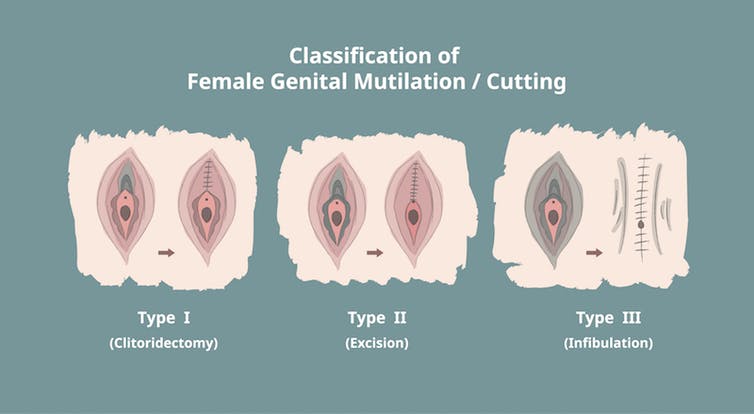
- FGM involves the partial or total removal of external female genitalia or other injury to the female genital organs for non-medical reasons.
- It is traditionally seen as a way of curbing female sexual desire in order to reinforce conservative behaviour.
- It is regarded as crucial prior to matrimony.
How prevalent is the practice?
- According to the UN, over 200 million women in several African countries have been subject to this brutal social custom.
- These include Sudan, Egypt, Nigeria, Djibouti and Senegal, and some countries in Asia.
- A 2014 U.N. children’s agency report estimated that 87% of Sudanese women and girls of 15-49 age group have been subjected to the procedure.
- Most undergo an extreme form known as infibulation, which involves the removal and repositioning of the labia to narrow the vaginal opening.
- The practice is not only a violation of every girl child’s rights, but is also harmful and has serious consequences for physical and mental health.
- There is ongoing research to rectify the damage.
- But WHO is somewhat unconvinced with the effectiveness of recent reconstruction surgeries.
What are the changes brought in?
- The government’s proposal is part of a set of sweeping amendments to the criminal code.
- They seek to scrap the repressive social codes and humiliating penalties that targeted women during the nearly 30-year dictatorship of Omar al-Bashir.
- Hundreds of Sudanese professionals had demanded a broad-based and inclusive constitutional order.
- Under the proposed amendments, anyone found guilty of performing the FGM procedure would be sentenced up to 3 years in prison.
- It would also abolish the death penalty for people under the age of 18.
- The amendment would also prevent pregnant women from being imprisoned for minor crimes.
- The law must still be ratified by a joint meeting of the Cabinet and the sovereign council.
- The council assumed power after the overthrow of long-time President Omar al-Bashir in 2019.
- The proposed law has been brought forward by the country’s interim government, which includes four female ministers.
What are the challenges?
- Rights groups have warned that the practice remained deeply entrenched in the conservative society.
- This suggests that legislation alone may not stop the practice that has deep cultural roots.
- Notably, female genital mutilation has survived in other countries that have criminalised the practice too.
- Moreover, Sudan is still in a transition from dictatorship to democracy.
- It is unclear whether the country’s military leaders, who make up a majority of the sovereign council, will approve the law.
- The changes if approved could spark a backlash by powerful Islamist groups that backed al-Bashir.
- So, working in coordination with the communities and raising awareness is essential to enforce this law.
- Also, sustaining the country’s progressive elements and democratic transition would be crucial to consolidate the gender reforms it has introduced in recent months.
Source: The Hindu


