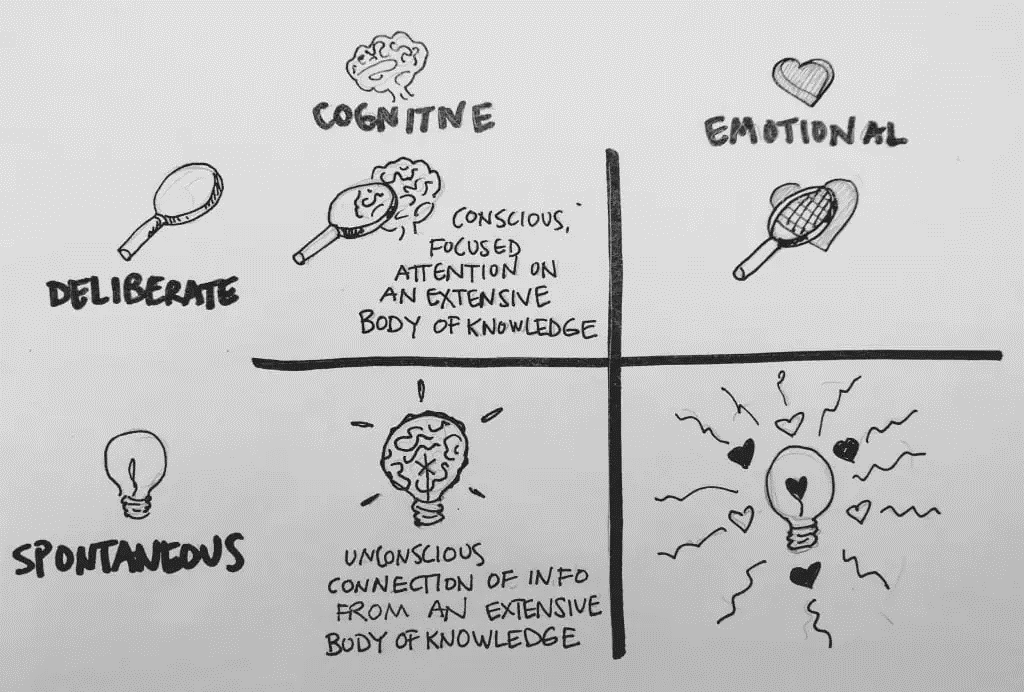
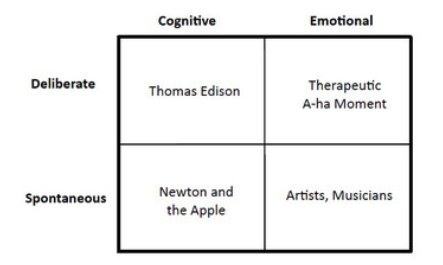
- Creativity can be segmented into four types.
- Deliberate and emotional - It's a process where individuals consciously explore their emotional landscape to deepen creative output and tap into insights from their experiences.
- Deliberate and cognitive - Creativity that is deliberate and cognitive comes from hard work in a particular area.
- Thomas Edison, the inventor of the electric light bulb (improved from the invention of Joseph Swan) and the telegraph, is a great example of a deliberate and cognitive creator.
- His work involved doing experiments repeatedly, making tweaks as he did, until something finally worked.
- Spontaneous and emotional – It is characterized by unplanned, instinctive idea generation driven by strong emotional impulses.
- This style is often associated with artists, musicians, and other creative individuals who thrive on flexibility and emotional expression.
- Spontaneous and cognitive – It involves a burst of insight or inspiration that leads to a solution, often while the mind is not actively focused on the problem
- Source of creativity - Creativity can be endogenous ,triggered by one’s own thoughts or imagination or exogenous, that is externally induced.
- Manifestation - It can be manifested concurrently or only episodically such as in crises or extreme climate events.
- Innovation - Creativity precedes innovation. While creativity can be individual-based, innovation can be bootstrapped but needs an institution to support its scale or formalisation.
|


