Why in news?
The US Food and Drug Administration (FDA) gave emergency approval to use the drug remdesivir for critical Covid-19 patients.
What is Remdesivir?
- It was manufactured in 2014 to treat for Ebola, by US-based biotechnology firm Gilead Sciences.
- It has since been used to treat for MERS and SERS, both caused by members of the coronavirus family.
- Current research is looking at whether the drug’s antiviral properties work against SARS-CoV2, the coronavirus that causes Covid-19 disease.
What does the Remdesivir do?
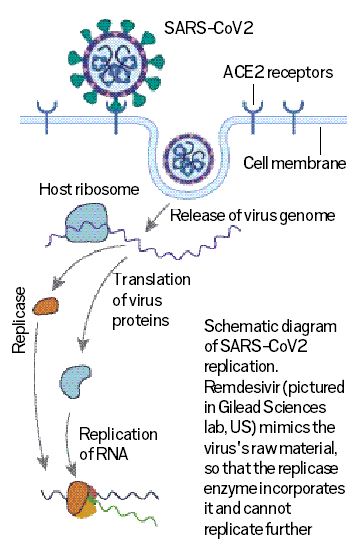
- The drug remdesivir is designed to obstruct the novel coronavirus SARS-CoV2 at the stage of replication.
- At this stage, the virus creates copies of itself, followed endlessly by the copies creating copies of themselves.
- Researchers have described the exact mechanism of interaction between the virus and the drug.
How does replication take place?
- Once the virus enters the human cell, it releases its genetic material, which is then copied using the body’s existing mechanism.
- At every stage of infection, various human proteins, virus proteins, and their interactions come into play.
- At the replication stage, the key protein of the virus at play is an enzyme called RdRp.
- RdRp makes copies by processing components of the RNA of the virus.
- Scientifically, such an enzyme is called a polymerase or a replicase.
- In any case, RdRp is the enzyme that is targeted by remdesivir.
How does remdesivir target the RdRp enzyme?
- In order to replicate, RdRp processes raw material from the RNA of the virus, broken down by another enzyme with that specific function.
- When a patient is given remdesivir, it mimics some of this material, and gets incorporated in the replication site.
- With remdesivir replacing the material it needs, the virus fails to replicate further.
What are some new findings?
- As far as SARS-CoV2 is concerned, a Chinese research paper has added to the emerging knowledge about the action of remdesivir.
- They have imaged the high-resolution structure of the SARS-CoV-2 replicase complex, with remdesivir bound to it.
- The structure shows where the RNA template of the virus enters the replication spot.
- It also shows where the remdesivir is incorporated, and where the process of replication is terminated.
Source: The Indian Express


