Prelims - Current events of national and international importance | History of India
Mains (GS-I)- Indian Heritage and Culture
Why in News?
Recently, Nagpur University researchers have unearthed a potentially 3,000-year-old Iron Age civilization in Maharashtra's Yavatmal district.
- Prime site of excavation – It was a mound that produced a cultural deposit measuring around 8.73 meters in thickness, indicating a multi-period and extensive occupation.
In archaeology, mounds commonly describe zones of long human settlement, in which soil and rubbish of a cultural nature accumulate over centuries or millennia.
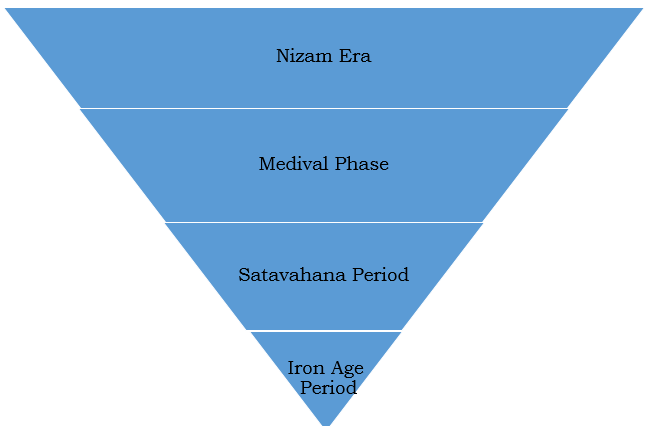
- Findings – It revealed a multi-layered settlement with distinct cultural periods.
|
1st Cultural Phase - Iron Age
|
- It represents the base layer of the settlement.
- Artefacts such as iron instruments and certain classes of pottery were found.
|
|
2nd Cultural Phase - Satavahana period
|
- It presents their inhabitation in the Deccan plateau, from about the 2nd century BCE to the 3rd century CE.
- Artefacts of this era included ceramic shapes and other artefacts typical of this transformative period in history.
|
|
3rd Cultural Phase - Medieval phase
|
- Settlement contains evidence of reuse or reoccupation.
- Although it yielded fewer artefacts, their presence was sufficient to position it within the chronological sequence of the site.
|
|
4th Cultural Phase - Nizam period
|
- It is the highest occupation level.
- It indicates that the mound was subsequently reused as a watchtower during the 18th to 20th century.
|
- Architectural observation - Remains of round houses, a feature commonly used by early agrarian and tribal communities.
- The houses featured limestone floors, which indicate some planning and stability in building.
- Wooden posts has been inserted around the perimeter of the houses, probably to frame organic material roofs such as thatch and wood.
- There was a house plan with a chulha or mud oven suggesting that there was a dedicated cooking space in the house.
- Artefacts findings – Different styles and textures of pottery.
- Iron tools, beads made of semi-precious stones, terracotta beads and bone artifacts were also found.
- Significance – It offer insights into the daily lives and technological advancements of the ancient inhabitants.
- Excavated artefacts reveal that they were also involved in craft, trade, and perhaps ritualistic practices.
- The findings of beads can be seen to reflect involvement in broader trading circles or cultural exchange with the outside world.
- Future prospects – Organic samples were sent to the Inter University Accelerator Centre (IUAC) in New Delhi to reach a correct timeline.
- Accelerator Mass Spectrometry (AMS) dating, a highly precise technique employed to estimate the age of ancient materials by measuring carbon isotope decay, will be carried out by the IUAC.
Reference
Times of India| Discovery of Multi-cultural Settlement in Maharashtra


