|
Anti-Aircraft Artillery (AAA)
|
- They fire shells rapidly, at rates of over 1,000 rounds per minute.
- AAA shells are designed to explode at predetermined altitudes so as to disperse shrapnel over a wide area.
- This makes an AAA battery effective even if it does not achieve a direct hit.
- When augmented with automated fire-control systems, they remain crucial last-ditch defences, and are also used for specialised anti-unmanned aerial vehicle (UAV) roles.
|
|
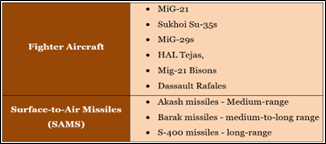
Fighter aircrafts
|
- These agile aircraft can be scrambled at a moment’s notice, and they climb quickly to altitude and neutralise an enemy aircraft before it deploys its weapons.
- Interceptors are equipped for air-to-air combat with cannon, rockets, a suite of visual-range and beyond-visual-range missiles, and electronic warfare systems.
|
|
Surface-to-Air Missiles
|
- They are more effective than anti-aircraft artillery (AAA), and do not put pilots in danger like interceptors.
- They are radar-, infrared-, or laser-guided. In addition to being operated from the ground, SAMs can also be launched from ships.
- Heavy long-range systems which are fixed or semi-mobile;
- Medium-range vehicle-mounted systems that can fire on the move
- Short-range man-portable air-defense systems (or MANPADS)
|
|
Electronic Warfare
|
- It is most often used to jam enemy radar and targeting systems, so as to impede its ability to accurately and effectively deploy its weapon.
- It can confuse attack drones or prevent enemy air-to-surface missiles from homing in on targets.
- These can operate from both land and air, including from specialised EW aircraft, such as the US Navy’s Boeing EA-18G Growler.
|