Why in news?
- The outbreak of acute encephalitis syndrome (AES) in Bihar has led to close to 350 cases and around 100 deaths.
- While the causes of AES are still researched, the association with hypoglycaemia and litchi fruit has drawn attention.
What is AES?
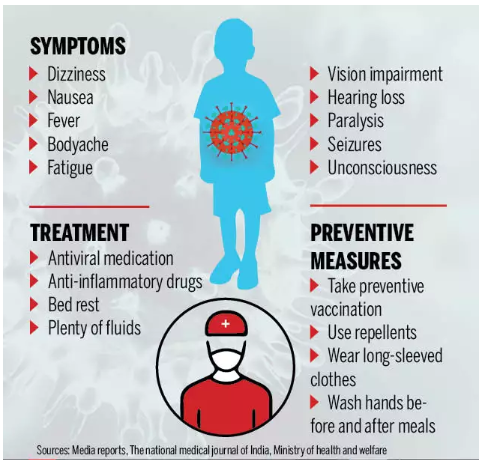
- Acute Encephalitis Syndrome (AES) is a broad term involving several infections, and it affects young children.
- AES is not a disease;it is a syndrome.
- Under its umbrella comes the hypoglycaemia, Japanese Encephalitis, Herpes meningitis, Race syndrome, cerebral malaria, scrub typhus, etc.
- All of them are grouped under AES as they have a classical triad of sudden onset of fever, convulsions and loss of consciousness.
How prevalent is AES?
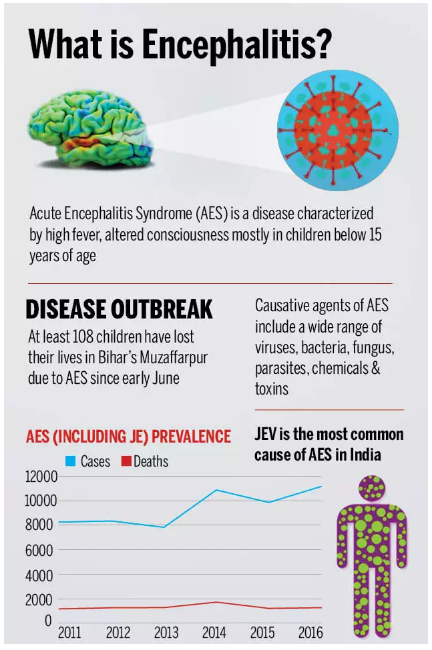
- The first AES case was recorded in 1995 in Muzaffarpur, Bihar.
- Eastern Uttar Pradesh too sees frequent outbreaks.
- There is no fixed pattern, but a year with high temperature and scanty rain usually witnesses high cases.
- Last year, there had been very few cases (in Muzaffarpur) because the general pattern of a few days of high temperature followed by rain showers was there.
- There were 143 deaths in 2013 and 355 in 2014, which dropped to 11 in 2017 and 7 in 2018.
- But this year, the heat has been prolonged with no spells of rain.
What causes AES?
- The syndrome can be caused by viruses, bacteria or fungi.
- In India, the most common cause is the virus that causes Japanese encephalitis (JE).
- Health Ministry estimates attribute 5-35% of AES cases to the JE virus.
- In Bihar, the Directorate of Health Services claimed that the JE virus had caused only two of the total 342 AES cases this year.
- The syndrome is also caused by infections such as scrub typhus, dengue, mumps, measles, and even Nipah or Zika virus.
- In the latest outbreak in Muzaffarpur, the cause is yet to be clinically identified in most of the children.
How is hypoglycaemia linked to AES?
- Hypoglycaemia (low blood sugar) is a commonly seen sign among AES patients, and the link has been the subject of research for long.
- The combination of AES with hypoglycaemia is unique to Muzaffarpur, Vietnam and Bangladesh.
- A 2014 study in Muzaffarpur suggested that hypoglycaemia was the trigger that led to diagnosis of encephalitis.
- So, Hypoglycaemia is not a symptom but a sign of AES.
- With 98% of AES patients in Bihar also suffering hypoglycaemia, doctors are attributing deaths to the latter.
- In Bihar, convulsions in children (which is AES) are found in combination with hypoglycaemia.
What is the litchi connect?
- Early researcheshave drawn parallel between cases in Bihar’s Muzaffarpur and in Vietnam’s Bac Giang province.
- In both places, there were litchi orchards in the neighbourhood.
- Methylene cyclopropyl glycine (MCPG), also known as hypoglycin A, is known to be a content of litchi fruit.
- Undernourished children who ate litchi during the day and went to bed on an empty stomach presented with serious illness early the next morning.
- When litchi harvesting starts in May, several workers spend time in the fields.
- There, it is common for children to feed on fallen litchis and sleep without food.
- The toxin in litchi (MPCG) lowers blood sugar level during night, and these children are found unconscious in the morning.
- Blood glucose falls sharply causing severe brain malfunction (encephalopathy), leading to seizures and coma, and death in many cases.
- However, this remains a subject of debate, and the possible association needs to be documented.
What role does malnutrition play?
- If toxins from litchi were causing hypoglycaemia, then these cases should have remained consistent each year.
- Also, it should have affected children of all socio-economic strata.
- But in contrast, this year, all deaths have been recorded in the lower income groups.
- While well-nourished children eating litchi remain unaffected even if they go to bed on an empty stomach, the under-nourished ones were at grave risk.
- This is because under-nourished children lack sufficient glucose reserve in the form of glycogen.
- Also, the production of glucose from non-carbohydrate source is unsafe as it is unsustainable and thus stopped midway.
- This leads to low blood sugar level, giving way for further health complications.
- In all, even if litchi is a triggering factor, the real cause for adverse effects is said to be malnutrition.
- So, while the cause of AES is still being researched, hypoglycaemic AES may be caused by malnutrition, heat, lack of rain, and entero-virus.
What makes Bihar and UP so vulnerable?
- Malnutrition is high in both states, and malnourished children are prone to infection.
- As per Health Ministry data, UP and Bihar together account for over 35% of child deaths in the country.
- National Family Health Survey-4 data show that in 2015-16, 48% children aged less than 5 in Bihar were stunted, which is the highest in India.
- Also, heat, humidity, unhygienic conditions and malnutrition which are unique to these areas, together contribute to the rise in AES.
- Incidence is higher in litchi fields around which malnourished children live.
What are the measures taken?
- In 2014, 74% of sick children were saved through a simple intervention by infusing 10% dextrose within 4 hours of the onset of illness.
- [Infusing dextrose is necessary to completely stop the attempt by the body to produce glucose from non-carbohydrate source.]
- Also, the prevention strategy of ensuring that no child goes to bed without eating a meal was adopted from 2015.
- This ensured a sharp drop in the number of children falling sick.
- The Bihar government introduced free vaccines at all primary health centres.The current coverage is 70%.
- The central and state governments have also conducted awareness campaign asking people not to expose their children to sun.
- Also, ensuring a proper diet and increased fluid intake were insisted.
- Besides these, early hospital referral and standard treatment for convulsions, high fever and vomiting can save lives.
Source: Indian Express, The Hindu
Quick Fact
Litchi
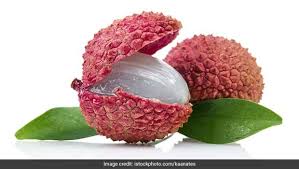
- Lychee, (Litchi chinensis), also spelled litchi or lichi, is an evergreen tree of the soapberry family (Sapindaceae).
- Lychee is native to Southeast Asia.
- Lychee is of local importance throughout much of Southeast Asia and is grown commercially in China and India.
- They require very little pruning and no unusual attention, though they should have abundant moisture around the roots most of the time.
- The trees come into production at 3 to 5 years of age.
Dextrose
- Dextrose is the name of a simple sugar that is made from corn and is chemically identical to glucose, or blood sugar.
- Dextrose is often used in baking products as a sweetener, and can be commonly found in items such as processed foods and corn syrup.
- For medical purposes, it is dissolved in solutions that are given intravenously, which can be combined with other drugs, or used to increase a person’s blood sugar.
- As dextrose is a “simple” sugar, the body can quickly use it for energy.
- Simple sugars can raise blood sugar levels very quickly, and they often lack nutritional value.


